
Quick Overview
Ex Works vs FOB are two Incoterms 2020 rules that define how costs, responsibilities, and risks are divided between buyers and sellers.
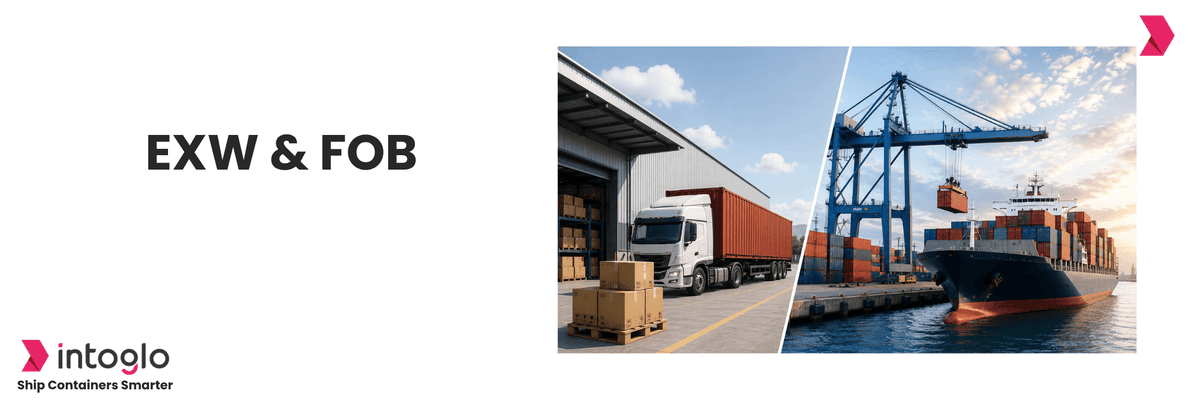
The key difference is simple: under EXW, the seller makes the goods available at their premises, while under FOB, the seller is responsible for getting the goods to the port and loading them onto the vessel.
For Indian exporters shipping to the USA, choosing between EXW and FOB can affect pricing, export documentation, origin logistics, and control over the shipment.
Key Facts about Ex Works vs FOB at a Glance:
- EXW places minimal logistics responsibility on the seller.
- FOB requires the seller to handle export clearance and deliver the goods on board the vessel.
- Under both terms, the buyer generally pays the main ocean freight.
- Under EXW, risk transfers at the seller's premises.
- Under FOB, risk transfers once the goods are loaded on board the vessel.
- EXW can create practical challenges with export clearance for international shipments.
- For containerized cargo, FCA may be more appropriate than FOB in many cases.
What Is Ex Works (EXW)?
EXW, or Ex Works, places most transportation responsibility on the buyer.
The seller's primary responsibility is to make the goods available at an agreed location, such as their factory or warehouse. The buyer then arranges pickup, export clearance, transportation to the port, ocean freight, import clearance, duties, and final delivery.
Example: EXW India
Suppose an Indian manufacturer sells goods to a US buyer on EXW Ahmedabad terms.
The seller makes the cargo available at its facility. The buyer is responsible for arranging transportation from Ahmedabad, export formalities, movement to the port, ocean freight to the USA, US customs clearance, and final delivery.
This gives the buyer greater control over logistics but also puts more responsibility on them.
One important consideration is export clearance. Since the buyer is responsible for export formalities under EXW, this can be difficult when the buyer is based outside India. The ICC therefore recommends considering FCA where appropriate for international transactions.

What Is FOB?
FOB, or Free On Board, is designed for sea and inland waterway transport.
Under FOB, the seller is responsible for getting the goods to the agreed port, completing export customs formalities, and loading the goods onto the vessel nominated by the buyer.
Once the goods are on board, the risk transfers to the buyer. The buyer then handles the main ocean freight, import clearance, duties, and transportation after arrival.
Example: FOB India
If an exporter sells goods on FOB Nhava Sheva, the exporter generally handles the cargo movement to the port, export customs clearance, and loading onto the vessel.
The buyer arranges the ocean freight and destination-side logistics.
EXW vs FOB: Comparison
| Responsibility | EXW | FOB |
| Goods preparation | Seller | Seller |
| Pickup from seller | Buyer | Seller |
| Export clearance | Buyer | Seller |
| Inland transport to port | Buyer | Seller |
| Loading onto vessel | Buyer | Seller |
| Main ocean freight | Buyer | Buyer |
| Import clearance | Buyer | Buyer |
| Import duties/taxes | Buyer | Buyer |
| Risk transfers | Seller's premises | Once goods are on board |
EXW vs FOB: Which Should an Indian Exporter Choose?
The right choice depends on who has better control over origin logistics and export procedures.
EXW can make sense when:
- The buyer has a logistics partner or operations team in India.
- The buyer wants control over transportation and freight booking.
- The seller wants to keep its logistics responsibilities minimal.
FOB can make sense when:
- The exporter already manages export documentation and customs.
- The exporter has reliable origin transportation and port arrangements.
- The buyer wants the seller to manage the shipment up to vessel loading.
For Indian exporters, FOB can also make the commercial quotation easier for buyers to understand because origin transportation and export-related costs are included in the seller's responsibility.
However, there is an important consideration for containerized shipments. The ICC notes that FCA can be more suitable than FOB for container cargo, because FOB's delivery point is tied to loading on board the vessel, while FCA can transfer responsibility when the goods are handed over to the carrier.
EXW vs FOB for India-USA Shipments
For an India-USA FCL shipment, the Incoterm should be evaluated alongside the total landed cost, not simply the exporter's product price.
An EXW quotation may look cheaper because the seller excludes origin logistics. But the buyer must add pickup, export clearance, origin charges, ocean freight, import costs, and final delivery.
With FOB, more origin-side costs are handled by the exporter, while the buyer takes responsibility for the main international freight and destination-side costs.
Therefore, exporters should clearly define:
- Named place or port
- Who arranges inland transportation
- Who handles export customs clearance
- Who books the ocean freight
- Where risk transfers
- Which additional origin and destination charges are excluded
Clear Incoterm definitions can prevent disputes over who is responsible for costs and shipment risks.
How Intoglo Helps
Choosing between EXW and FOB affects your total landed cost and how much control you have over the shipment. Intoglo helps Indian exporters structure the right Incoterm for India-USA FCL shipments - managing origin pickup, export clearance, ocean freight, and US delivery under one roof. Get a quote from Intoglo.
Stay updated on trade terms, tariffs, and shipping regulations through our free monthly India-USA Trade Pulse webinar.
📩 contact@intoglo.com 📞 +91 84697 08714
Conclusion
The simplest way to understand Ex Works vs FOB:
EXW = Seller makes the goods available.
FOB = Seller gets the goods on board the vessel.
For Indian exporters shipping to the USA, the choice should depend on who can manage origin logistics more efficiently, who needs control over freight, and how the total landed cost is structured.
Choosing the right Incoterm is not just about quoting a price. It determines who handles the shipment, who pays for each stage, and where the risk changes hands.
FAQs
Is EXW cheaper than FOB?
The seller's price is generally lower under EXW because the seller has fewer logistics responsibilities. However, the buyer must account for additional origin and transportation costs.
Who pays ocean freight under EXW?
The buyer arranges and pays for the main international freight.
Who pays ocean freight under FOB?
The buyer generally arranges and pays for the main ocean freight, while the seller manages transportation to the port and loading onto the vessel.
Is FOB better than EXW for Indian exporters?
Not always. FOB can be more convenient when the exporter has established control over origin logistics and export clearance. EXW can work when the buyer has strong logistics capabilities in India.
Should exporters use FOB for container shipments?
FOB is a sea/inland-waterway Incoterm, but the ICC recommends considering FCA for containerized cargo, depending on the shipment structure.