
Quick Overview
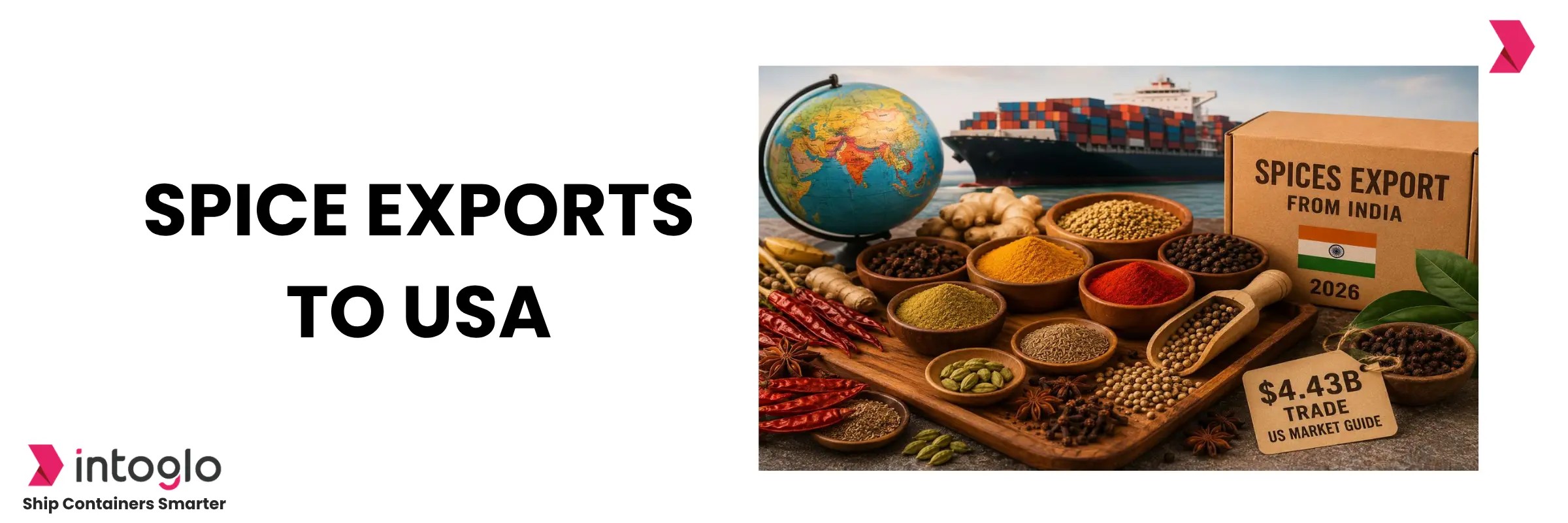
Spices export from India reached 17.34 lakh tonnes worth ₹39,140.11 crore (US$4.43 billion) in 2025-26. Chilli was the largest export category by value, while the USA remained India's biggest individual destination, accounting for 14% of export value. For exporters targeting the US, however, market demand is only one part of the equation. CRES registration, FDA requirements, FSVP, product documentation and reliable ocean logistics all influence whether a shipment reaches the buyer without costly delays.
Key Facts About Spices Export from India:
- India exported 17.34 lakh tonnes of spices and spice products in 2025-26.
- Export value reached ₹39,140.11 crore, or approximately US$4.43 billion.
- The USA accounted for 14% of India's spice export value.
- Chilli represented 27% of export value.
- Cumin and spice oils and oleoresins each represented 12%.
- Turmeric contributed 7%, while curry powder and paste contributed 6%.
- Spice exporters require a Certificate of Registration as Exporter of Spices (CRES).
Which Spices Does India Export?
India exports both whole spices and processed spice products. Chilli remains the largest category, followed by cumin, spice oils and oleoresins, cardamom, mint products and turmeric.
| Spice category | Share of export value, 2025-26 |
| Chilli | 27% |
| Cumin | 12% |
| Spice oils & oleoresins | 12% |
| Small cardamom | 9% |
| Mint products | 8% |
| Turmeric | 7% |
| Curry powder & paste | 6% |
These figures show that India's spice trade extends well beyond bulk whole spices. Processed products such as oils, oleoresins and curry blends also represent significant export value.

India’s Top Spice Export Markets
The USA is currently the most important individual destination for Indian spices, accounting for 14% of export value in 2025-26.
Other major markets include China, the UAE, Bangladesh, Saudi Arabia, the UK, Thailand, Malaysia, Indonesia, Germany, the Netherlands, Canada, Nepal and Australia.
For Indian exporters, the US market is particularly important because it combines strong demand with strict food-import requirements. A shipment therefore needs to meet both the buyer's commercial specifications and US regulatory requirements.
What Registration Is Required to Export Spices?
Indian exporters need a Certificate of Registration as Exporter of Spices (CRES) from the Spices Board.
The Board states that CRES is mandatory for exporting or importing spices and spice products. Applications are processed through the DGFT system, with separate requirements for manufacturer exporters and merchant exporters.
Depending on the exporter category, supporting documents can include GST registration, bank reports, FSSAI licensing, MSME documentation and documents relating to the processing facility.
Exporters should complete the relevant registration before accepting commercial orders for export.
What US Requirements Apply to Indian Spices?
Spices imported into the USA fall under the food-safety framework administered by the U.S. Food and Drug Administration (FDA).
FDA has identified spices as a food category requiring particular attention because of potential microbiological and other contamination risks. The agency has also highlighted India as a major source of spice imports into the United States.
For US-bound shipments, exporters and their US buyers should review:
- FDA food-facility requirements
- Food safety and contamination controls
- Product and ingredient information
- US labelling requirements
- Import documentation
- Foreign Supplier Verification Program requirements
The FSVP is particularly relevant to the US importer. Covered importers must verify that their foreign suppliers meet applicable US food-safety requirements.
What Documents Are Needed for Spice Exports?
Documentation depends on the product and destination, but a commercial shipment may require:
- Commercial invoice
- Packing list
- Shipping Bill
- Bill of Lading
- Certificate of Origin, where required
- Product testing or analysis certificates, where applicable
- Insurance documents, where applicable
- Applicable food-safety and regulatory documentation
The information across these documents should remain consistent. Differences in product descriptions, quantities, packaging or classification can create clearance issues.
Spice exporters should also maintain their required regulatory records and submit applicable export returns to the Spices Board.
What Should Spice Exporters Consider When Shipping?
Spices can move as bulk commodities, packaged food products or processed ingredients. Therefore, shipping requirements vary by product.
Moisture protection:
Spices can be sensitive to humidity during ocean transportation. Appropriate packaging and container preparation can reduce moisture-related damage.
Cargo handling:
Packaging should protect the product from contamination, odour transfer and physical damage during handling.
Container utilization:
Larger and regular orders may make FCL more economical, particularly when exporters can use most of the available container capacity.
Destination costs:
US drayage, customs clearance, terminal charges and final delivery can significantly affect the landed cost.
Transit planning:
Documentation or customs delays can result in storage, demurrage or detention costs if the container remains at the destination beyond the permitted free time.
For regular India-USA shipments, exporters should therefore compare the complete landed logistics cost, rather than looking only at the ocean freight rate.
How Intoglo Helps
For spice exporters shipping from India to the USA, freight is only one part of the shipment. Container planning, documentation, customs coordination, US drayage and final delivery all affect the final landed cost.
Intoglo coordinates India-USA FCL shipments from origin through US delivery, helping exporters manage ocean freight, documentation, customs coordination, drayage and final delivery through one logistics partner.
Planning your next shipment to the USA? Get a quote from Intoglo.
Stay informed about carrier announcements, freight rates, and trade regulations by joining our free 30-minute monthly India-USA Trade Pulse webinar.
📩 contact@intoglo.com 📞 +91 84697 08714
Conclusion
India's spice exports reached US$4.43 billion in 2025-26, with the USA accounting for 14% of export value. For exporters targeting the US, successful market access depends on more than product demand. CRES registration, FDA compliance, FSVP coordination, accurate documentation and careful FCL planning all play a role in keeping shipments compliant and commercially viable.
Frequently Asked Questions
Is CRES mandatory for spice exports from India?
Yes. The Spices Board states that a Certificate of Registration as Exporter of Spices (CRES) is mandatory for the export or import of spices and spice products.
Which spice does India export the most?
Chilli is currently the largest contributor to India's spice export earnings, accounting for 27% of export value in 2025-26.
Is the USA a major market for Indian spices?
Yes. The USA accounted for 14% of India's spice export value in 2025-26, making it India's largest individual export destination for spices.
Do Indian spice exporters need FDA compliance for the USA?
US food imports are subject to FDA requirements. Spice exporters should work with their US importer to understand the applicable food-safety, facility, labelling and import requirements.
Who is responsible for FSVP?
The FSVP requirements generally apply to the US importer of the food, who must verify that the foreign supplier and imported food meet applicable FDA food-safety requirements.
What are the major spice export markets from India?
Major destinations include the USA, China, UAE, Bangladesh, Saudi Arabia, UK, Thailand, Malaysia, Indonesia, Germany, the Netherlands, Canada, Nepal and Australia.