
Quick Overview
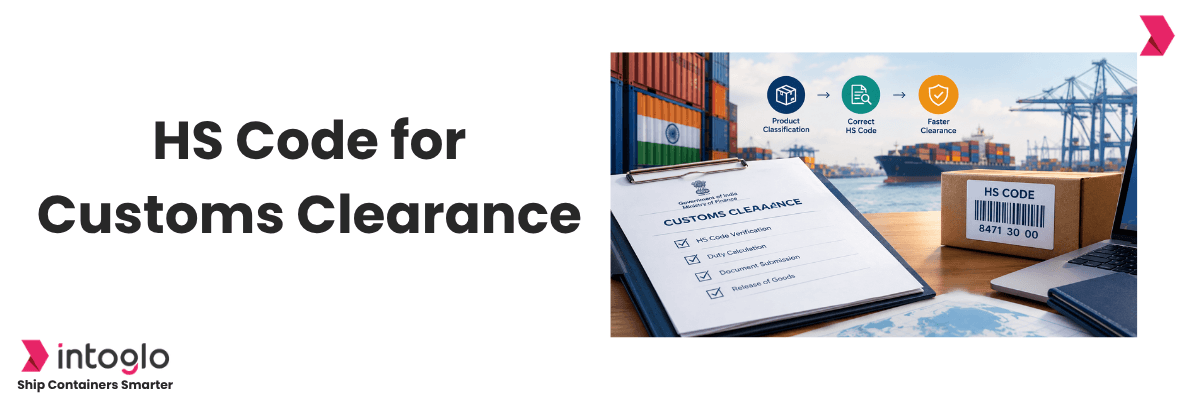
An HS Code for Customs Clearance identifies goods under India's customs classification system and helps determine applicable duties, export policies, and compliance requirements. ICEGATE and DGFT provide official tools and information for checking the relevant classification before an export shipment is filed.
Key Facts About HS Code for Customs Clearance:
- HS codes classify goods for customs and international trade.
- India uses eight-digit ITC(HS) tariff classifications.
- Classification can affect duties and export-policy requirements.
- ICEGATE provides tools to search tariff classifications.
- Exporters should verify codes before filing shipping documents.
How HS Codes Work in India?
The Harmonized System provides a common structure for classifying traded goods internationally. The first six digits generally follow the international HS system, while India uses additional digits under its ITC(HS) classification.
India's ITC(HS) uses eight-digit tariff items covering specific products and categories. The first two digits identify the chapter, the next two identify the heading, followed by increasingly specific classifications.
However, exporters should not select an HS code based only on a commercial product name. Material, composition, function, technical characteristics, processing, and intended use can influence classification.
Why HS Classification Matters?
The HS code does more than identify a product. It can determine the applicable customs duty, export-policy treatment, restrictions, exemptions, and compliance requirements.
ICEGATE allows exporters to search tariff information by product description or Customs Tariff Heading and review relevant duty and compliance information.
For exporters, the classification can also affect whether additional documentation, permissions, or specific regulatory requirements apply.
| Classification Factor | Why It Matters |
| Product characteristics | Helps establish the correct classification |
| ITC(HS) code | Determines the tariff item |
| Export policy | Identifies applicable restrictions or conditions |
| Notifications | May affect duties or exemptions |
| Compliance requirements | Identifies additional approvals or documents |
How to Find the Correct HS Code?
Start with the actual characteristics of the product. Check its material, composition, function, technical specifications, form, and intended use rather than relying only on the commercial name.
Then search the product through ICEGATE's tariff tools and compare the available descriptions with the goods being exported. ICEGATE Compliance Portal can also provide commodity-specific regulatory information.
Finally, verify the current DGFT export-policy position and applicable notifications before filing the shipment.

Common HS Code Mistakes
One common mistake is selecting a code based only on the product's commercial name. Similar products can fall under different classifications depending on their characteristics and function.
Another mistake is copying the HS code from an older shipment without checking the current tariff. Classification structures, descriptions, and policy conditions can change.
Exporters may also confuse the international six-digit HS classification with India's eight-digit ITC(HS) tariff item. The additional digits can be important when completing Indian customs documentation.
Inconsistent product descriptions across documents can create further questions during customs processing.
What Happens If the HS Code Is Wrong?
An incorrect classification can result in incorrect duty calculation, reassessment, additional scrutiny, or shipment delays. It can also create compliance problems if the selected code carries specific export requirements.
ICEGATE's Compliance Information Portal provides commodity-wise procedures, regulatory requirements, applicable duties, and information from relevant government agencies.
Therefore, exporters should verify classification before filing rather than correcting the issue after customs raises a query.
How Intoglo Helps
Intoglo helps India-USA exporters coordinate FCL shipping, documentation, customs processes, U.S. drayage, warehousing, and final delivery through one workflow.
Accurate product information and consistent documentation can help exporters reduce avoidable customs coordination issues.
Planning your next shipment to the USA? Get a quote from Intoglo.
For updates on freight rates, carrier announcements, tariffs, and India–USA shipping trends, join our free 30-minute monthly India–USA Trade Pulse webinar.
📩 contact@intoglo.com | 📞 +91 84697 08714
Conclusion
The correct HS Code for Customs Clearance helps exporters classify goods accurately and understand applicable duties and export requirements. Before filing, exporters should verify the current ITC(HS) classification, tariff description, export policy, and relevant notifications.
Q&A
What is an HS code?
It is a standardized system used to classify traded goods.
How many digits does India's ITC(HS) code have?
India uses eight-digit ITC(HS) tariff classifications.
Where can exporters check HS codes?
ICEGATE and DGFT provide official classification resources.
Can similar products have different HS codes?
Yes. Classification can depend on composition, function, and technical characteristics.
Can an incorrect HS code delay clearance?
Yes. It can lead to customs queries, reassessment, or additional checks.