Quick Overview
For enterprise shippers moving FCL (Full Container Load) cargo from India to the USA, selecting the right freight rate structure is important for balancing cost, shipment flexibility, and space availability. In FCL shipping, one exporter books an entire container for cargo movement.
These pointers explain the three main FCL freight rate structures used:
- Spot Rates: Freight rates quoted at the time of booking are based on current market conditions.
- Monthly Rates: Fixed freight rates valid for 30 days with no long-term commitment.
- Direct Liner Contracts (NAC Filing): Long-term freight agreements with shipping lines that include committed shipment volumes.
Many enterprise shippers also use a hybrid approach that combines monthly and spot rates to reduce risk and improve flexibility.
Understanding how these freight models work helps enterprise shippers choose the right strategy based on shipment volume, market conditions, and operational requirements.
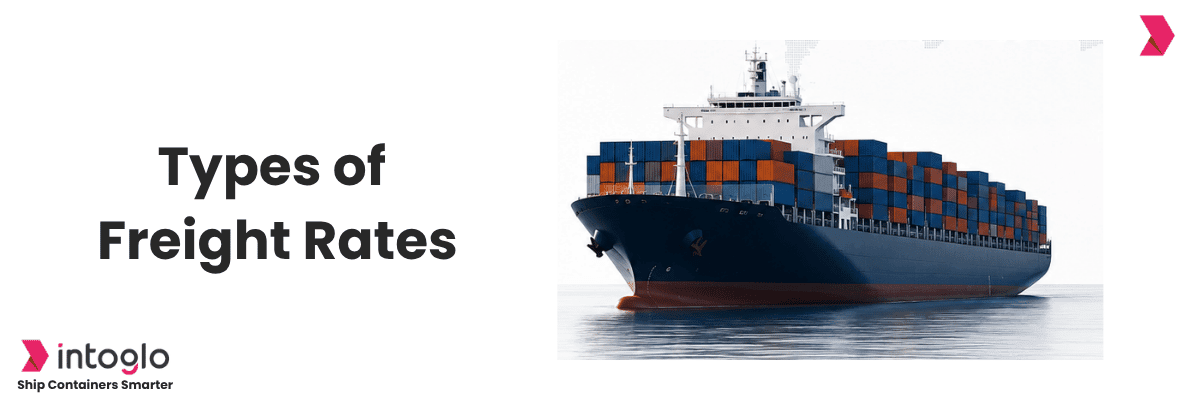
Types of Freight Rates
Freight rates differ in pricing stability, flexibility, and volume commitment. Here is how the three models work for Indian exporters shipping FCL cargo to the USA.
1. Spot Rates
Spot rates are freight rates quoted at the time of booking and are usually valid for one day. They change based on market demand, vessel space, and container availability. There is no volume commitment, making them suitable for urgent shipments or irregular cargo volumes. However, rates can increase during peak season or congestion.
2. Monthly Rates
Monthly rates are fixed freight rates valid for 30 days. They provide short-term pricing stability without any minimum volume commitment, making them suitable for exporters with regular shipment volumes. However, exporters cannot benefit if market freight rates fall during the validity period.
3. Direct Liner Contracts
Direct liner contracts, also called NAC (Named Account Contract) filing, are agreements between the shipper and the shipping line for fixed freight rates and committed container volume under annual or semi-annual contracts.
What Is NAC Filing?
NAC filing allows exporters to negotiate directly with shipping lines such as Maersk, MSC, or Hapag-Lloyd.
To qualify, exporters typically need:
- 50+ FCL containers per month.
- Commitment to a Minimum Quantity Commitment (MQC).
- Ability to pay penalties for volume shortfalls.
- A direct relationship with the shipping line.
If the MQC is not met, the shipping line may charge penalties for the unshipped volume.
Side-by-Side Freight Rate Comparison
The table below compares the key differences between spot rates, monthly rates, and direct liner contracts for FCL exporters shipping from India to the USA.
| Factor | Spot Rates | Monthly Rates | Direct Liner Contracts |
| Validity | Day-to-day | 30 days | 6–12 months |
| Pricing | Market-driven | Fixed for 30 days | Locked at signing |
| Space Guarantee | No | Partial | Yes |
| Volume Commitment | None | None | Yes (MQC applies) |
| Best For | Urgent or one-off cargo | Regular monthly volumes | 50+ containers/month |
| Peak Season Risk | High | Moderate | Low |
| Flexibility | High | Moderate | Low |
The Hybrid Approach: Combining Monthly and Spot Rates

Many enterprise shippers use a hybrid freight strategy that combines monthly and spot rates instead of committing to direct liner contracts.
Direct liner contracts usually require annual or semi-annual MQC-based volume commitments, which can become risky during changing market and geopolitical conditions. For better flexibility, many enterprise shippers check the latest monthly and spot rates with their freight forwarder before placing bookings on the India-USA trade lane.
Intoglo helps enterprise shippers access the latest spot and monthly freight rates through direct liner contracts with major shipping lines such as Maersk, Hapag-Lloyd, CMA CGM, ONE, and COSCO. Shippers can also use Intoglo’s Instant Quote feature to quickly access real-time rates and streamline the booking process.
How it works in practice:
- Use monthly rates for regular shipment volumes to maintain short-term cost stability.
- Use spot rates for overflow cargo, urgent shipments, or when market rates become more favorable.
- Review freight rates monthly instead of locking pricing under long-term contracts.
- Avoid MQC penalties, since spot and monthly rates do not require volume commitments.
This strategy helps enterprise shippers respond more effectively to changing freight rates and vessel capacity conditions.
How Intoglo Supports Enterprise Shippers
Intoglo is a digital freight forwarder focused exclusively on the India–USA trade lane, serving high-volume enterprise shippers in their India - US FCL shipments. With teams operating across India and the USA time zones, direct liner contracts, and deep expertise in one trade lane, helps us to deliver superior service levels for enterprise shippers.
Key capabilities include:
- Spot and monthly rate bookings with transparent pricing.
- End-to-end FCL execution including pickup, customs, documentation, tracking, and delivery.
- Direct coordination with shipping lines, customs brokers, and truckers in the USA.
- Real-time shipment visibility and tracking.
- Delivery coverage across 41,000+ US ZIP codes.
- Support for high-volume export categories such as auto parts, chemicals, paper & packaging, and pharmaceuticals.
- Strong carrier relationships to help reduce cargo rollover risk during peak seasons.
Trusted by 200+ businesses, Intoglo helps enterprise shippers simplify freight operations across the India–USA trade lane.
Need help with your shipment? Reach out to Intoglo:
📩 contact@intoglo.com | 📞 +91 84697 08714
Conclusion
Choosing the right FCL freight rate structure is critical for enterprise shippers seeking to manage costs and maintain supply chain stability. While direct liner contracts offer space security, they also carry volume commitments and financial risk. For many enterprise shippers, a combination of monthly and spot rates provides the right balance of flexibility, pricing control, and reduced exposure to market uncertainty.
FAQs
Can any Indian exporter get a direct liner contract?
Not automatically, you typically need to ship 50 or more FCL containers per month consistently. The shipping line will also expect you to commit to a Minimum Quantity Commitment (MQC) for 6 to 12 months. Falling short means paying penalties.
What happens if I miss my MQC under a direct liner contract?
The shipping line invoices you for the containers you committed to but did not ship. These penalties are written into the contract and are difficult to waive. This is the single biggest risk for Indian exporters who overestimate their future volumes.
Are spot market freight rates cheaper than contract rates?
Not always, spot rates may be lower during periods of excess capacity, but can increase quickly during peak seasons or capacity shortages.
What role do freight forwarders play in enterprise FCL shipping?
Freight forwarders help in booking coordination, shipment execution, customs handling, tracking, and communication across carriers and trade lanes.