Quick Overview
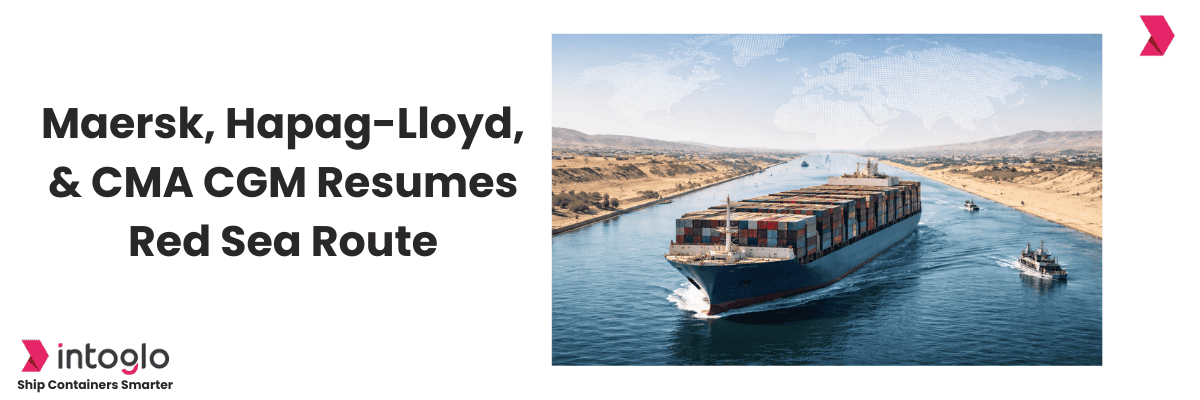
Maersk, Hapag-Lloyd, and CMA CGM are resuming their services through the Suez Canal. This article explains why the carriers are returning to the Red Sea, outlines the operational and security risks, provides vessel details, and highlights the impact on transit times, shipping costs, and Indian exporters.
Maersk and Hapag-Lloyd have confirmed that Gemini service vessels will resume transits through the Suez Canal from mid-February 2026. CMA CGM has already resumed its services via the Suez.
This is a significant shift, as container ships had avoided the Red Sea and Suez for over two years due to Houthi attacks, forcing vessels to reroute around the Cape of Good Hope resulting in longer transit times and higher operating costs.
What is the ME11 / IMX Service?
The ME11 (IMX) is a container trade service linking India and the Middle East with the Mediterranean.
Cargo moves from ports such as Mundra and Nhava Sheva, transits through Middle East hubs, passes via the Suez Canal, and reaches Mediterranean ports including Valencia.
Key Details of the Route Resumption
The Gemini Cooperation partners have outlined specific operational details for the resumption of Red Sea transits, beginning with a single service under heightened security measures.
- The route resumption is being undertaken by Gemini Cooperation partners Maersk and Hapag-Lloyd.
- The ME11 / IMX service has been confirmed as the first Gemini service to resume transit via the Red Sea and Suez Canal.
- The service is scheduled to restart from mid-February 2026.
- The first westbound sailing operated by Albert Maersk, departed Mundra, India, on February 4, while the first eastbound sailing, Astrid Maersk departed Valencia, Spain, on February 3.
- Vessels transiting the Red Sea will sail under naval escort to address ongoing regional security risks.
CMA CGM has already resumed services via the Suez Canal for India–US East Coast shipments. You can read more in our dedicated article: CMA CGM Restarts INDAMEX Route via Suez Canal for India-US East Coast.
Reduced Transit Times from India-US in February
The Suez route resumption is reducing transit times for shipments from India to the USA. Transit time to New York is now 25–30 days compared to 35 days earlier, and will eventually improve to 21–24 days.
Vessel Schedules & Transit Times
1. Maersk
- Vessel Name: MAERSK KENSINGTON 607W
- ETD Nhava Sheva: 20/02
- Current Transit Time: 25 Days
- Earlier Transit Time: 32 Days
2. Hapag-Lloyd
- Vessel Name / Schedule: Awaited
- Expected Impact: Quicker deliveries once schedule resumes
3. CMA CGM
- Vessel Name: CMA CGM MAUPASSANT
- ETD Nhava Sheva: 22/02
- Current Transit Time: 31 Days
- Earlier Transit Time: 35 Days
These faster transit schedules reduce journey times, improve vessel availability, and allow exporters to better plan shipments from India to the US.
These schedules and transit times may change, so it’s recommended to verify with your freight forwarder before booking.
Benefits of Resuming Suez Transit
As the three carriers are returning to the Suez Canal as security improves. Naval escorts reduce Houthi-related risks, enabling faster transit, better schedule reliability, and increased vessel capacity.
- 7–14 days shorter transit
- Lower fuel and operating costs
- ~7% higher vessel capacity globally
- Improved schedule predictability
This benefits India-USA trade flows. The route’s use depends on security conditions.
Why Does this Matter for Indian Exporters?
The partial return to Suez has direct implications for India-origin cargo flows.
- Faster delivery from India to US ports.
- Better vessel availability and service options.
- Improved supply chain planning due to shorter, more predictable routes.
However, security risks and elevated insurance costs remain key factors in routing and booking decisions.
With routes and schedules changing due to the partial return to Suez, exporters need up-to-date sailing information. Intoglo helps Indian exporters in schedule changes, vessel availability, and transit-time planning.
Download Intoglo’s updated monthly India-USA sailing schedule for India–USA shipments to plan your next move with clarity.
To explore how Intoglo can simplify and optimize your India–USA FCL shipping, connect with us:
📩 contact@intoglo.com | 📞 +91 84697 08714
Conclusion
The return of select services to the Suez route signals a measured shift toward faster and more efficient India-US east coast connectivity. While the move improves transit speed and network capacity, ongoing security concerns and insurance constraints continue to prevent a full return to regular operations.
FAQs
Will freight rates immediately drop due to the return to Suez?
Not immediately, while shorter routes reduce operating costs, freight rates will depend on how many services permanently return to Suez, insurance premiums, fuel prices, and overall demand. Any rate softening is likely to be gradual rather than sudden.
Are all India–USA services switching back to Suez?
No, currently only selected Gemini services are resuming Red Sea transits. Other services may continue routing via the Cape of Good Hope until carriers gain sustained confidence in regional security.
How does this impact transit time reliability compared to Cape routing?
Suez routing generally offers shorter and more predictable transit times, but reliability will still depend on security conditions, convoy scheduling, and potential last-minute route changes
Does naval escort mean zero risk for cargo?
No, Naval escorts reduce risk but do not eliminate it. This is why insurers still classify the Red Sea as a high-risk zone, leading to elevated premiums or restricted coverage.
How can I find out which vessels are currently transiting via the Suez Canal?
Exporters can check with their freight forwarder, who has the latest schedules and can confirm if a shipment will transit via the Suez Canal. Shipping line portals for Maersk, Hapag-Lloyd, and CMA CGM also provide routing and schedule information. Since routes can change due to security or operational reasons, it is always recommended to verify the latest details with your freight forwarder before booking shipments.