Quick Overview
AES filing is a mandatory U.S. compliance step required before your shipment to the USA, and missing it can cause delays or fines. This article explains what AES is, when it’s needed for Indian exporters, key terms like EEI and ITN, who files it, and how the process works for smooth customs clearance.
You’ve booked your FCL container and the cargo is ready, but your freight forwarder asks: "Has AES been filed?"
AES filing is mandatory before cargo departure. If missed or incorrect, it can cause customs holds, documentation delays, or penalties- affecting timelines and costs.
What Is the Automated Export System (AES)?
AES is an electronic filing platform maintained by the U.S. Census Bureau. It collects Electronic Export Information (EEI), essentially a digital record of every significant export shipment leaving U.S. shores.
When goods from India arrive at a U.S. port or transit through the U.S., AES filing ensures that U.S. authorities have a complete, accurate record of those goods. The system feeds data to two key agencies:
- U.S. Census Bureau: Uses the data to compile national trade statistics.
- U.S. Customs and Border Protection (CBP): Uses the data to enforce export laws and screen for restricted goods.
AES replaced the old paper-based Shipper's Export Declaration (SED) in 2008. It is now done electronically through a portal called AESDirect, which sits within the ACE (Automated Commercial Environment) system.
Why Does AES Filing Matter for Indian Exporters?
When you export from India to the USA, your cargo is subject to U.S. import and export regulations at the destination. AES filing is part of those regulations. Here's why it matters directly to you:
- Legal requirement: The U.S. Foreign Trade Regulations (FTR) mandate AES filing for qualifying shipments. Non-compliance is a federal offence.
- Customs clearance: Incorrect or missing filings can hold up your container at the destination port, costing you demurrage and delaying your buyer.
- Export controls: The U.S. government screens shipments for restricted technology, dual-use goods, and sanctioned parties. AES is the primary tool for this.
- Trade data accuracy: Your shipment data contributes to bilateral India-USA trade statistics. Accurate data benefits both governments during trade negotiations.
When Is AES Filing Mandatory?

Not every shipment requires AES filing, but most commercial exports from Indian businesses to the USA will qualify.
- Shipment value exceeds $2,500: Per Schedule B commodity classification, regardless of transport mode.
- Ocean freight shipments: AES is required for all FCL and LCL exports by sea, a common route for Indian exporters.
- Goods requiring an export licence: Including technology, chemicals, and defence-related items, regardless of value.
- Transit shipments: Goods transiting through the U.S. en route to another country also require AES.
If you're a regular exporter of garments, engineering goods, pharmaceuticals, chemicals, or any manufactured product to the USA, AES filing almost certainly applies to your shipments.
Important AES Terms Every Exporter Should Know
Before you ship to the USA, it’s important to understand these common AES terms, as they are used during filing and documentation.
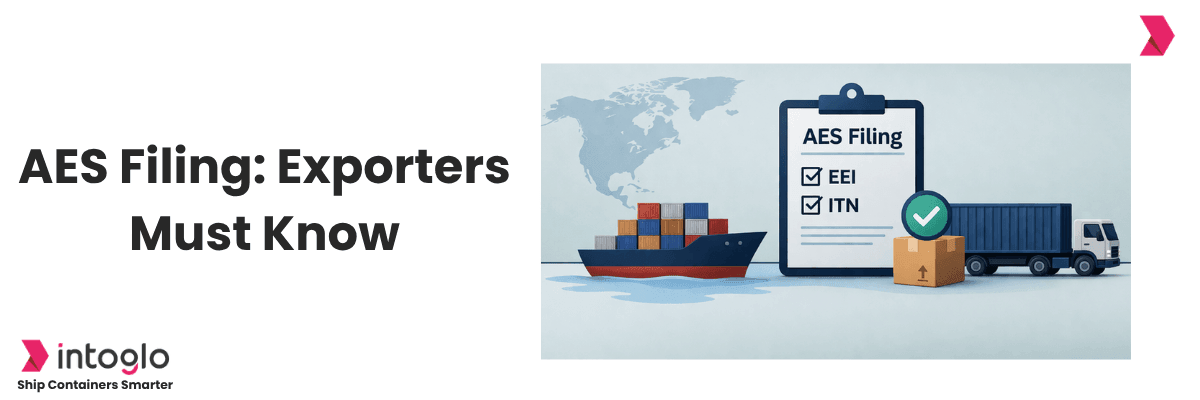
- EEI (Electronic Export Information): The shipment details filed in AES. It replaces the old paper SED form.
- ITN (Internal Transaction Number): The confirmation number generated after successful AES filing. The shipping line/carrier needs this before departure.
- USPPI (U.S. Principal Party in Interest): The U.S. party responsible for the export filing, usually your buyer or their customs broker.
- Schedule B Number: A product classification code used to identify your goods in the AES system.
- AESDirect: The online portal (inside ACE) where AES filings are submitted.
Who Files AES: The Exporter or the Freight Forwarder?
This is a common question for Indian exporters. Technically, the USPPI (U.S. Principal Party in Interest) is responsible for filing AES. However, in most cases, the AES filing is done by a U.S. customs broker or freight forwarder on behalf of the exporter.
Always confirm with your freight forwarder that AES has been filed and ask for the ITN before the vessel departs.
No ITN = no departure clearance.
How Does the AES Filing Process Work?
AES filing is a critical step for Indian exporters, ensuring all shipment details are submitted to U.S. authorities for smooth customs clearance.
1. Exporter or freight forwarder gathers shipment details: commodity description, Schedule B number, value, destination, and licence information if applicable.
2. Filing is submitted through AESDirect on the ACE portal before the cargo departs.
3. The AES system validates the filing. If accepted, an ITN is issued immediately.
4. The ITN is provided to the carrier and noted on the Bill of Lading or Airway Bill.
5. U.S. CBP reviews the data. If everything is correct, the shipment proceeds without interruption.
For ocean shipments from India, AES is usually filed 24-72 hours before vessel departure. Your freight forwarder will confirm the exact deadline.
At Intoglo, we manage end-to-end FCL shipping from India to the USA, including AES coordination through our U.S. customs partners. Our services include door-to-door FCL shipping, origin pickup and CFS support, smooth customs clearance, destination handling, last-mile delivery, and real-time tracking.
Get in touch with Intoglo for any queries or hassle-free shipping:
📩 contact@intoglo.com | 📞 +91 84697 08714
Conclusion
AES filing is a mandatory U.S. compliance requirement to prevent delays, fines, or shipment holds. Indian exporters must ensure it is filed correctly through their freight forwarder or customs broker. Using an experienced forwarder helps manage compliance smoothly and avoid last-minute issues.
FAQs
Is AES filing done in India or in the USA?
AES filing is a U.S. government requirement and is filed on the U.S. side - typically by a U.S. customs broker or freight forwarder acting on behalf of the exporter. Your Indian freight forwarder coordinates with their U.S. partner to ensure this is completed before the vessel departs.
Does AES filing apply to all my FCL shipments to the USA?
Yes, in most cases. If your shipment value exceeds $2,500 per commodity (which most commercial FCL shipments do), AES filing is mandatory. Ocean freight shipments require AES regardless of value in many cases.
What happens if my buyer's customs broker files AES incorrectly?
Incorrect filings can result in fines of up to $10,000 per violation and potential shipment delays or holds at the U.S. port. Always ask for the ITN as proof of a successful filing and verify it is correct before the ship sails.
Can I self-file AES as an Indian exporter?
AES filing requires access to the ACE portal, which is a U.S. government system. As an Indian exporter, you will typically rely on a U.S.-based customs broker or freight forwarder.