Quick Overview
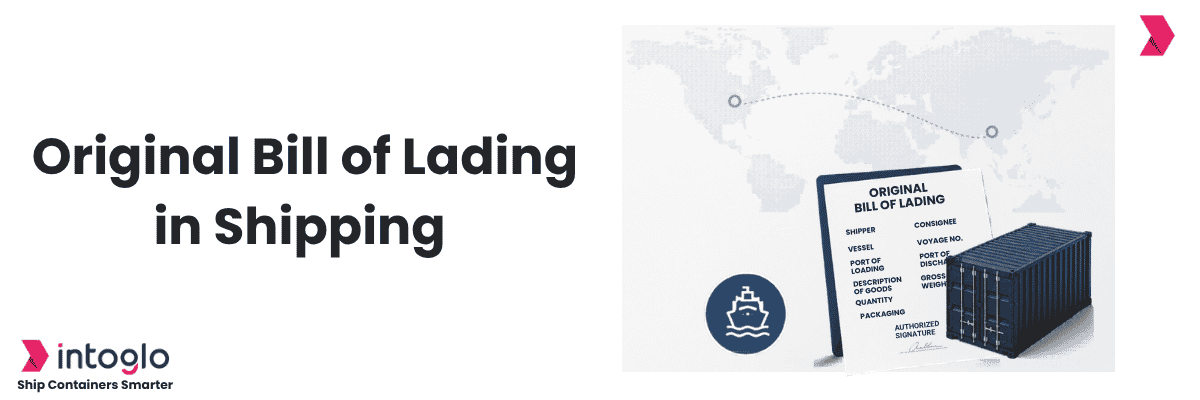
An Original Bill of Lading (OBL) is a legally binding shipping document issued by the carrier to the shipper that acts as a contract of carriage, proof of shipment, and legal title of ownership. In simple terms, whoever holds the original OBL controls the right to collect the cargo at the destination port, making it one of the most important documents in ocean freight shipping.
Here are the key basics exporters should know before shipping:
- The Original Bill of Lading is usually issued in 3 original copies, and submitting any one original is enough to release the cargo.
- It includes critical shipment details like the shipper and consignee names, cargo description, quantity, packaging, shipment date, and declared value.
- It is required for customs clearance, port release, and trade compliance.
- Banks may hold the OBL under a Letter of Credit (LC) until payment terms are met.
- Cargo can also be released through Telex Release or Express Release to avoid physical document delays.
Now that you have a quick understanding of what an OBL is and why it matters, let’s break down its functions, release types, and how it impacts cargo clearance at the destination port.
What is an OBL?
An Original Bill of Lading (OBL) is a legally binding document issued by the carrier to the shipper. It serves simultaneously as a contract of carriage, a receipt for the goods, and a title of ownership. The party holding the OBL has the legal right to claim the cargo at the destination port.
Functions of an Original Bill of Lading
The Original Bill of Lading performs multiple critical functions that ensure secure, compliant, and smooth international cargo movement.
1. Title of Cargo and Shipment Receipt
The OBL confirms that the carrier received the goods in the declared condition and quantity. The holder of the OBL has the legal right to claim the cargo, making it both proof of receipt and proof of ownership.
2. Detailed Item and Shipping Information
The OBL records item descriptions, quantity, packaging, shipping terms, and consignee details. This helps ensure accurate documentation and reduces disputes during transit.
3. Shipment Release Requirement
The consignee must present the OBL at the destination port to claim the cargo. Without it, the carrier will not release the goods, protecting against unauthorised access.
4. Surrender for Receipt
The OBL is usually issued as a set of 3 original copies (along with non-negotiable copies). Submitting any one signed original copy is enough to release the cargo, and the remaining originals automatically become invalid.
Types of Releases Associated with OBL
Not every shipment uses the traditional OBL handover. Two faster alternatives exist, which are:
1. Telex Release
In a Telex Release, the shipper surrenders the OBL at the origin port. The carrier then electronically authorises the destination port to release the cargo without requiring the physical OBL. This is commonly used when documents are delayed or faster cargo release is needed.
2. Express Release
An Express Release, also called a Sea Waybill, does not require an Original Bill of Lading. Instead, the consignee is pre-registered by the shipper at the time of booking, and the carrier releases the cargo based on identity verification alone - no physical document needed. This makes it generally used for regular shipments between trusted parties where the consignee is known and fixed from the start.
How OBL Affects Cargo Release at Destination?

At the destination port, the OBL controls every step of cargo release:
1. Proof of ownership: Only the OBL holder can claim the goods, preventing unauthorised access.
2. Documentation requirements: Customs and port authorities require it to process legal clearance.
3. Security and control: Maintains supply chain integrity by ensuring cargo reaches only the rightful party.
4. Payment and financing: Banks may hold funds until the OBL is presented, securing financial transactions.
5. International trade compliance: Standardises the transfer process, reducing disputes between parties.
6. Insurance claims: Essential documentation to substantiate any damage or loss claim during transit.
In cases where faster cargo release is needed, Telex Release and Express Release serve as alternatives to the physical OBL. These options can expedite the release process, provided the carrier approves and the required conditions are met.
OBL Documentation and Compliance
An Original Bill of Lading contains key shipment and cargo details required for customs clearance, cargo release, and trade documentation.
Details Within an OBL
An Original Bill of Lading contains key shipment and cargo details required for customs clearance, cargo release, and trade documentation.
| OBL Detail | Description |
| Shipper and Consignee Information | Full names and addresses of the sender and receiver. |
| Shipment Date | Date the goods were loaded onto the vessel. |
| Goods Description | Type, quantity, and packaging details of the cargo. |
| Value of Goods | Declared cargo value used for customs duties, taxes, and insurance. |
Clean Original Bill of Lading
A Clean OBL has no notations indicating damage or discrepancies at loading. It is required for title transfer and for payment release - banks need it to confirm the shipment is as agreed before funds are disbursed to the seller.
Managing OBL documentation correctly is essential for smooth shipping and timely cargo release. At Intoglo, we help exporters manage customs clearance and shipment documentation for India-USA trade. Whether you are exporting for the first time or shipping regularly, our team helps reduce delays, documentation errors, and compliance issues.
Contact Intoglo for your next India–USA shipment.
📩 contact@intoglo.com | 📞 +91 8469708714
Conclusion
The Original Bill of Lading (OBL) is a critical document in international shipping that governs cargo ownership, shipment verification, and goods release at the destination port. Understanding how the OBL works - including release types, documentation requirements, and compliance rules helps exporters avoid delays, documentation issues, and cargo release complications.
FAQs
What is an Original Bill of Lading (OBL)?
An OBL is a legally binding shipping document that serves as a title of ownership, a shipment receipt, and a cargo release requirement all in one. Whoever holds it has the right to claim the goods.
How many original copies of an OBL are issued?
Typically, 3 originals are issued. Surrendering any one of them is sufficient to release the cargo. The remaining copies become void automatically.
What is the difference between OBL and Bill of Lading (BL)?
BL is a broad term covering all types of originals and copies. The OBL is the specific original that carries legal weight for ownership transfer. Copies alone cannot be used to claim goods at the destination.
What is a Telex Release?
A Telex Release allows the consignee to receive cargo without presenting the physical OBL. The shipper surrenders it at the origin, and the carrier electronically authorises release at the destination port.
Why do banks require the OBL?
Banks use the OBL as collateral in trade finance - particularly for letters of credit. It assures them that goods have been shipped as agreed before they release funds to the seller.
What happens if the OBL is lost?
A lost OBL causes serious delays. The consignee may need to provide an indemnity letter or bank guarantee to get a Letter of Indemnity (LOI) from the carrier for cargo release. Always store it securely.
Can cargo be released without the original OBL?
Yes, but only through a Telex Release or Express Release, subject to carrier approval and specific conditions. Without these alternatives, the carrier will not release goods without the physical OBL.