Quick Overview
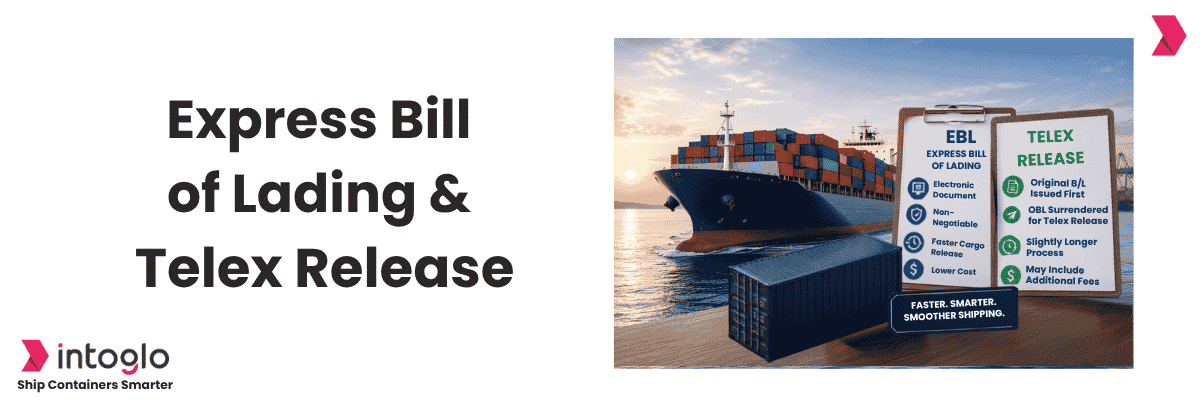
An Express Bill of Lading (EBL) is a non-negotiable shipping document that allows cargo to be released without the issuance of a physical Original Bill of Lading. A Telex Release allows cargo to be released at the destination without presenting the Original Bill of Lading, provided the shipper surrenders all original copies to the carrier.
Here are the key things exporters should know about EBL and Telex Releases:
- EBLs typically offer a faster documentation process because no original documents need to be printed, couriered, or surrendered.
- Telex Releases may involve additional processing time and carrier fees due to the Original Bill of Lading surrender requirement.
- Both options help speed up cargo release and reduce reliance on physical document transfers.
- Neither is generally suitable for Letter of Credit (LC) transactions that require negotiable shipping documents.
- EBLs are commonly used for open-account shipments between trusted trading partners.
- Telex Releases are often used when shipment terms change after an Original Bill of Lading has already been issued.
Before comparing the two options in detail, it is important to understand the core difference between an Express Bill of Lading and a Telex Release.
The Core Difference
The main difference between an Express Bill of Lading (EBL) and a Telex Release is how the shipment is documented and released.
- Express Bill of Lading: No physical Original Bill of Lading is issued. The shipment is non-negotiable from the beginning, allowing cargo to be released without original documents.
- Telex Release: A physical Original Bill of Lading is issued first. After the shipper surrenders it to the carrier, the carrier authorises cargo release at the destination without requiring the original document.
For a deeper understanding of both shipping documents, explore our dedicated articles What is an Express Bill of Lading & When Should Exporters Use It? and What is a Telex Release in Shipping? A Complete Guide
Express Bill of Lading vs Telex Release: Comparison

Both Express Bills of Lading and Telex Releases allow cargo to be released without presenting an Original Bill of Lading at the destination. The comparison below highlights the key differences exporters should understand before choosing either option.
| Factor | Express Bill of Lading (EBL) | Telex Release |
| Original Bill of Lading Issued | No physical Original Bill of Lading is issued. | Physical Original Bill of Lading is issued and later surrendered. |
| How It Works | Shipment is set up as non-negotiable from the start and transmitted electronically. | Carrier releases cargo after receiving and processing the surrendered OBL. |
| Speed | Faster, with no paper documents to manage. | Slightly slower due to the OBL surrender process. |
| Cost | Lower administrative and document handling costs. | May include Telex Release and courier fees. |
| Letter of Credit Compatibility | Not suitable for LC transactions. | Not suitable for LC transactions. |
| Risk Level | Lower risk because no physical OBL exists. | Higher risk as the OBL exists before surrender. |
| Best Suited For | Open-account trade, repeat buyers, and trusted business relationships. | Shipments where an OBL was initially required but later became unnecessary. |
| Carrier Availability | Supported by most major carriers on India–USA routes. | Widely accepted by carriers worldwide. |
When to Choose an Express Bill of Lading?
An Express Bill of Lading is best suited for shipments where speed, simplicity, and efficiency are priorities. Consider using an EBL when:
- You trade with a trusted buyer under open-account terms, and no bank or Letter of Credit is involved.
- You want a simple, cost-effective documentation process with no physical Bill of Lading to manage.
- You regularly ship on established India–USA trade lanes with predictable shipping procedures.
- Fast cargo release is a priority, and you want to avoid delays caused by document handling.
When to Choose a Telex Release?
Consider a Telex Release when you want to avoid presenting an Original Bill of Lading at the destination after it has already been issued.
- You originally needed a negotiable Original Bill of Lading, but the buyer has completed payment before the shipment arrives.
- Your buyer's bank initially required an Original Bill of Lading for financing or documentation purposes, but the requirement has since been removed.
- The carrier or trade lane does not support an EBL as an option at the time of booking.
- You are transitioning an established trade relationship from traditional paper-based documentation to a faster and more streamlined process.
Mistakes to Avoid When Choosing Between EBL & Telex Release
Choosing the wrong document type can lead to delays, additional costs, and cargo release issues.
- Using Telex Release for new buyers: Surrendering the OBL removes your control over the cargo. Use it only after payment is received or secured.
- Requesting EBL when an LC is involved: EBLs and Telex Releases are non-negotiable and generally do not meet Letter of Credit requirements. Confirm documentation requirements before booking.
- Not confirming with the carrier: Carrier support for EBLs and Telex Releases varies by trade lane. Check availability at the time of booking.
- Ignoring amendment timelines: Changes to consignee or shipment details after issuing an EBL or processing a Telex Release may be difficult, costly, or not permitted.
To help exporters avoid these issues, Intoglo evaluates the payment terms, buyer relationship, and carrier options for every India-USA FCL shipment before recommending an EBL or Telex Release.
This helps ensure the right documentation is selected from the start, reducing the risk of delays, unnecessary charges, and cargo release complications. With direct carrier relationships and dedicated US trucking partners, Intoglo supports a smoother shipment process from origin to final delivery.
Need help with the India-USA shipment? Reach out to Intoglo.
📩 contact@intoglo.com | 📞 +91 84697 08714
Conclusion
Both Express Bills of Lading and Telex Releases eliminate the need to present a physical Original Bill of Lading at the destination, helping speed up cargo release. The best option depends on your payment terms, buyer relationship, and shipment requirements. Choosing the right documentation from the start can help avoid delays, reduce costs, and ensure a smoother shipping process.
FAQs
Can I switch from an EBL to a Telex Release mid-shipment?
No, an EBL means no physical OBL was ever issued, so there is nothing to surrender for a Telex Release. The document type is set at booking. If your requirements change, you will need to coordinate with the carrier on alternative solutions, which may involve delays and additional costs.
Is an EBL safer than a Telex Release?
In most cases, yes. Since no physical OBL exists with an EBL, there is no risk of the document being lost, stolen, or misused during transit. A Telex Release has a brief window between OBL issuance and surrender where document risk exists.
Are there any trade lanes where one is preferred over the other?
On high-volume India–USA lanes, EBLs are increasingly standard for open account trade. Telex Releases are more common on routes or with carriers where EBL infrastructure is less mature. Always confirm with your carrier.
Can a Telex Release be revoked after it is issued?
Once the Telex Release instruction is sent to the destination agent, reversal is extremely difficult and depends entirely on carrier cooperation. This is why verifying buyer credentials and payment status before surrender is critical.