Quick Overview
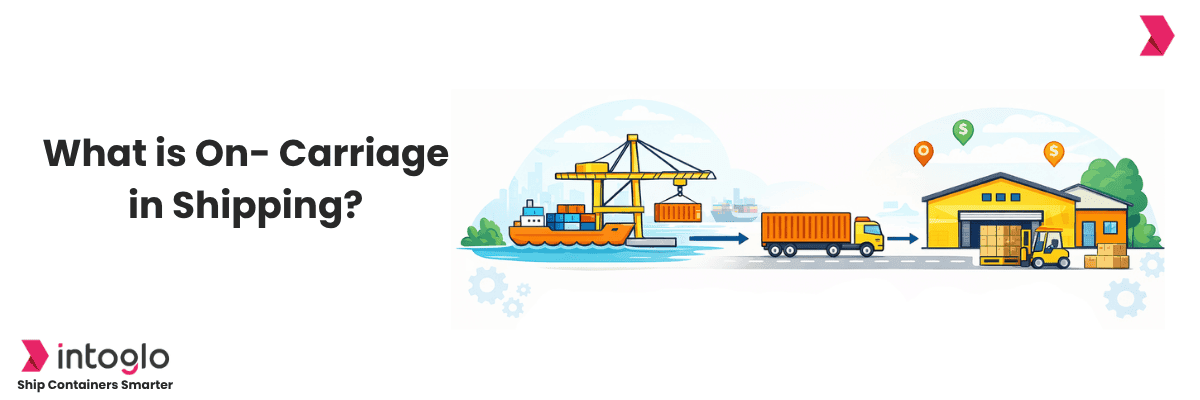
On-carriage is the movement of cargo from the destination port to the final delivery location, making it an important destination-side logistics cost for exporters shipping internationally.
Here’s what Indian exporters must know about on-carriage before planning shipments:
- There are two types of on-carriage haulage: carrier haulage and merchant haulage.
- In carrier haulage, the shipping line manages inland transport after the cargo reaches the destination port, while in merchant haulage, the exporter or appointed logistics partner arranges delivery.
- Responsibility for on-carriage costs depends on Incoterms - buyers usually pay under FOB, CFR, and CIF, while sellers pay under DAP, DDP, and DPU.
- Common on-carriage costs include drayage, inland trucking, cross-country delivery, last-mile transport, and detention or demurrage charges.
Now that you understand the role of on-carriage in the shipping journey, let’s explore how each haulage option works.
What Is On-Carriage in Shipping?
On-carriage means moving goods from the destination port to the final delivery location, such as a warehouse, distribution centre, store, or the buyer’s address.
In simple terms, it is the delivery that happens after the ship reaches the port. For Indian exporters shipping to the USA, this usually involves trucking the container from a US port like Los Angeles, New York, or Savannah to the buyer’s location.
Want to understand the first step of shipping before the container reaches the port? Read our complete article on What Is Pre-Carriage in Shipping? A Complete Guide for Indian Exporters.
Types of On-Carriage Haulage

1. Carrier Haulage
The shipping line takes responsibility for on-carriage from the port of discharge to the final delivery location. The shipping company arranges and manages inland transport at the destination end.
Example: Your Bill of Lading shows delivery to Dallas, and the shipping line delivers the container from Houston port to Dallas.
Carrier haulage at the destination is convenient but can be expensive. Always compare with merchant haulage rates at the destination.
2. Merchant Haulage
You or your appointed agent (freight forwarder or 3PL) arranges and pays for the inland transport from the US port to the final destination. You choose the transporter and control the delivery schedule.
Example: Your container arrives at Long Beach, and your logistics partner arranges a truck to deliver it to Phoenix.
Merchant haulage at destination gives you cost control and scheduling flexibility - especially valuable for time-sensitive or high-value shipments.
Who Pays for On-Carriage?
Your Incoterm determines whether you or your buyer pays for on-carriage.
- FOB, CFR, CIF: Buyer pays for on-carriage from the port of discharge to the final destination.
- DAP (Delivered At Place): Seller pays for on-carriage to a named place - usually the buyer's premises or a nearby point.
- DDP (Delivered Duty Paid): Seller pays for on-carriage plus customs duties and taxes in the destination country.
- DPU (Delivered at Place Unloaded): Seller pays for on-carriage and unloading at the named delivery point.
If you are shipping under DAP or DDP to a US buyer, you must include on-carriage costs in your price. If you don’t, your profit margin will reduce.
What On-Carriage Costs Should Indian Exporters Expect
On-carriage costs in the USA depend on the port, delivery distance, equipment availability, and how quickly the container is moved out of the terminal.
- Drayage: Moving the container from the port terminal to a nearby warehouse or depot.
- Inland trucking: Transporting the container from the port to inland cities.
- Cross-country trucking: Long-distance delivery across the US, depending on the final destination.
- Last-mile delivery: Extra charges if delivery involves multiple drop locations or appointment-based warehouses.
- Detention and demurrage: Daily penalties if the container is not picked up or returned on time. These can quickly add hundreds of dollars per day, especially at busy ports.
Always ask your freight partner for a clear cost breakup before finalizing your quote, so you don’t face unexpected destination charges.
To make this easier, Intoglo manages on-carriage as part of its door-to-door FCL shipping service from India to the USA. This means exporters can ship directly to the buyer’s location with a single coordinated logistics partner, ensuring smoother delivery planning and better cost visibility upfront.
Have queries about your India–USA shipment? Get in touch with Intoglo today:
📩 contact@intoglo.com | 📞 +91 84697 08714
Conclusion
On-carriage is the final and often most complex leg of your shipment. For Indian exporters selling on DAP or DDP terms, these costs are yours to manage and absorb. Work with a freight partner that gives you full visibility into on-carriage costs upfront. A transparent end-to-end quote protects your margins and builds trust with your US buyers.
FAQs
What is the difference between on-carriage and destination charges?
Destination charges are port or terminal fees for unloading and handling the container after it arrives (such as THC and port handling). On-carriage is the inland transport cost to move the container from the port to the final delivery location. Both apply at the destination and should be included in your total shipping cost.
What is the difference between on-carriage and last-mile delivery?
On-carriage refers to the entire inland movement from the port of discharge to the final delivery point. Last-mile delivery is the final portion of on-carriage, specifically the delivery from a local hub or warehouse to the end customer's address.
Under CIF terms, does the Indian exporter pay for on-carriage in the USA?
No, under CIF, the seller's responsibility ends at the destination port. The buyer arranges and pays for on-carriage from the port of discharge to the final destination. This is one reason CIF is a popular Incoterm for Indian exporters
What happens if my buyer refuses to arrange on-carriage under FOB terms?
Under FOB, the buyer is responsible for on-carriage. If they fail to arrange it, the container may incur detention charges at the port. Clarify on-carriage responsibilities clearly in your sales contract and confirm buyer readiness before the vessel departs India.
Can Intoglo handle both pre-carriage from India and on-carriage in the USA?
Yes, Intoglo offers complete door-to-door FCL services from India to the USA, covering pre-carriage (factory to Indian port), ocean freight, customs clearance, and on-carriage (US port to buyer's address).