Quick Overview
Pre-carriage is the movement of goods from your factory or warehouse to the port of loading - before the main ocean voyage begins. Under FOB, CFR, and CIF Incoterms, the seller (exporter) bears the cost of pre-carriage. Pre-carriage can be handled via carrier haulage (shipping line manages it) or merchant haulage (you or your agent arranges it).
Every international shipment starts long before the container touches the sea. For Indian exporters shipping to the USA, the first critical leg is pre-carriage - moving your goods from the origin to the loading port.
Get this leg wrong, and you face delays, missed vessel cutoffs, and unexpected costs. Get it right, and your shipment flows smoothly into the main ocean freight cycle.
What Is Pre-Carriage in Shipping?
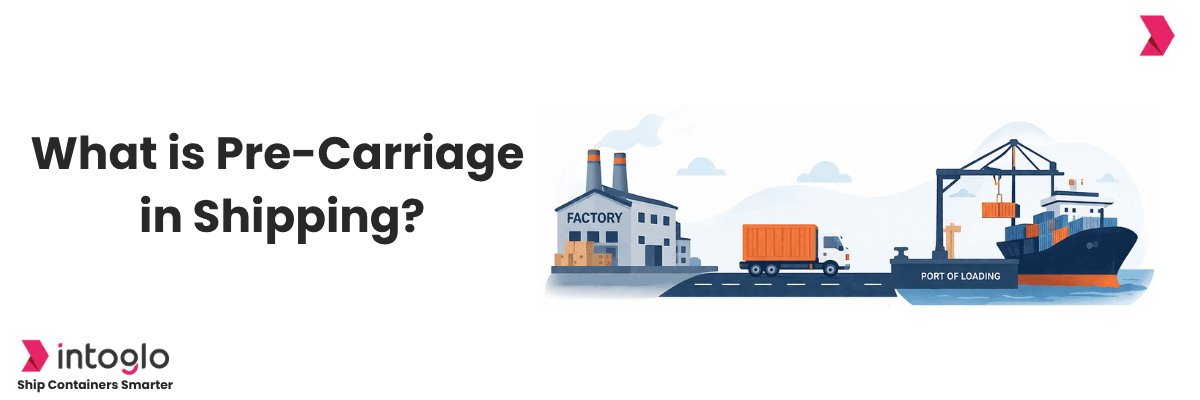
Pre-carriage refers to the transportation of goods from the point of origin, typically a factory, warehouse, or inland container depot (ICD), to the port of loading, where the cargo will be loaded onto the vessel for its main international voyage.
In simple terms, it is the leg before the ship. For Indian exporters, this often means trucking cargo from a manufacturing facility in Ludhiana, Surat, or Coimbatore to JNPT (Mumbai), Mundra, or Chennai port.
Types of Pre-Carriage Haulage

1. Carrier Haulage
The shipping line is responsible for transporting your goods from the origin to the port of loading. The shipping line arranges inland transport, manages logistics, and covers the cost under the freight agreement.
Example: Your Bill of Lading shows a 'Place of Receipt' as Pune. The shipping line will organise and pay for moving the container from Pune to JNPT Mumbai. You have nothing to arrange for that leg.
Carrier haulage is convenient - but you lose some control over timing and routing. Build this into your planning.
2. Merchant Haulage
You or your appointed freight agent arrange and pay for the inland transport to the port. You have full control over the transporter, route, and timing.
Example: Your goods are at a factory in Tiruppur. You hire a trusted road transporter to move the cargo to Chennai port. You manage the coordination, documentation, and cost directly.
Merchant haulage gives you more control and is often more cost-effective for exporters with strong inland logistics networks.
Who Pays for Pre-Carriage?
The Incoterm in your sales contract determines who bears the cost of pre-carriage.
- FOB (Free On Board): Seller (exporter) pays for pre-carriage to the port of loading.
- CFR (Cost and Freight): Seller pays for pre-carriage plus main freight to the destination port.
- CIF (Cost, Insurance, Freight): Seller pays pre-carriage, main freight, and insurance.
- EXW (Ex Works): Buyer arranges and pays for everything, including pre-carriage from your factory gate.
Always clarify Incoterms with your buyer before confirming freight arrangements. A mismatch in expectations leads to disputes over who owes what.
Pre-Carriage in FCL Shipping
In Full Container Load (FCL) shipments, pre-carriage is particularly important. You are moving an entire container; any delay at the pre-carriage stage can result in a missed vessel cutoff and an extra week's wait for the next sailing.
Key considerations for FCL pre-carriage from India:
- Stuffing location: Is the container stuffed at your factory (door pick-up) or at a CFS near the port?
- Container availability: Confirm equipment availability with the shipping line well in advance.
- Port cutoff timings: Different ports (JNPT, Mundra, Nhava Sheva) have different vessel cutoffs. Your pre-carriage must arrive on time.
- Document readiness: Shipping instruction deadlines must align with your pre-carriage timeline.
Common Pre-Carriage Challenges for Indian Exporters
- Traffic congestion near ports: Plan truck departure 24–48 hours before port cutoff to avoid delays near busy ports like JNPT.
- Transporter reliability: Vet your inland trucking partners carefully. A broken-down truck costs you the vessel.
- Permit and e-way bill compliance: For inter-state movement, ensure GST e-way bills are generated correctly to avoid checkpost delays.
- CFS congestion: Container freight stations near major ports can be congested. Factor in 6-12 hours of buffer time.
Intoglo simplifies pre-carriage by offering door-to-door FCL shipping from India to the USA. With PAN India trucking, factory stuffing support, port coordination, and transparent pricing, exporters can avoid last-minute disruptions and manage shipments smoothly without unexpected inland transport costs.
Need support with your India–USA export shipment? Connect with Intoglo today:
📩 contact@intoglo.com | 📞 +91 84697 08714
Conclusion
Pre-carriage is the foundation of a smooth export shipment. For Indian exporters, choosing between carrier haulage and merchant haulage and understanding your Incoterm obligations can directly impact your costs and delivery timelines. Plan your pre-carriage as carefully as your ocean freight. A well-managed first leg sets the tone for the entire shipment.
FAQs
What is the difference between pre-carriage and main carriage?
Pre-carriage is the inland movement from your factory to the port of loading. The main carriage is the ocean voyage from the port of origin to the port of destination. They are two separate legs of the same shipment.
Under FOB terms, does the Indian exporter pay for pre-carriage?
Yes, under FOB, the seller (Indian exporter) is responsible for delivering the goods to the port of loading, including all pre-carriage costs. The buyer takes over once the goods are on board the vessel.
Can I use my own transporter for pre-carriage even if the shipping line offers carrier haulage?
Yes, you can opt for merchant haulage and use your own transporter. Inform the shipping line at the time of booking. Merchant haulage gives you more control but also more responsibility.
How far in advance should I arrange pre-carriage for an FCL export from India?
For FCL shipments, confirm pre-carriage arrangements at least 5-7 days before the vessel cutoff date. For factory stuffing, coordinate container pick-up 3-4 days before the cutoff to allow buffer time for any delays.