Quick Overview
A Container Yard (CY) stores and handles full containers within the port area. A Container Freight Station (CFS) consolidates and deconsolidates cargo before export or after import. An Inland Container Depot (ICD) functions as a dry port, offering customs clearance and container handling services away from seaports.
These facilities form different operational layers in the shipping supply chain, each supporting a distinct stage of export and import movement.
- The Container Yard serves as a buffer zone, regulating container flow between vessels and terminal operations.
- Container Freight Station focuses on cargo grouping efficiency, especially for mixed shipments handled under LCL.
- Inland Container Depot shifts customs and container operations closer to inland trade and manufacturing hubs.
- Port operators use Container Yards (CYs) to support vessel scheduling and improve terminal productivity.
- CFS supports freight forwarders in optimizing cargo space utilization.
- ICD reduces dependency on coastal ports by decentralizing clearance and storage activities.
Understanding these roles helps exporters design cost-efficient and time-efficient logistics routes across domestic and international supply chains.
What is a Container Yard?
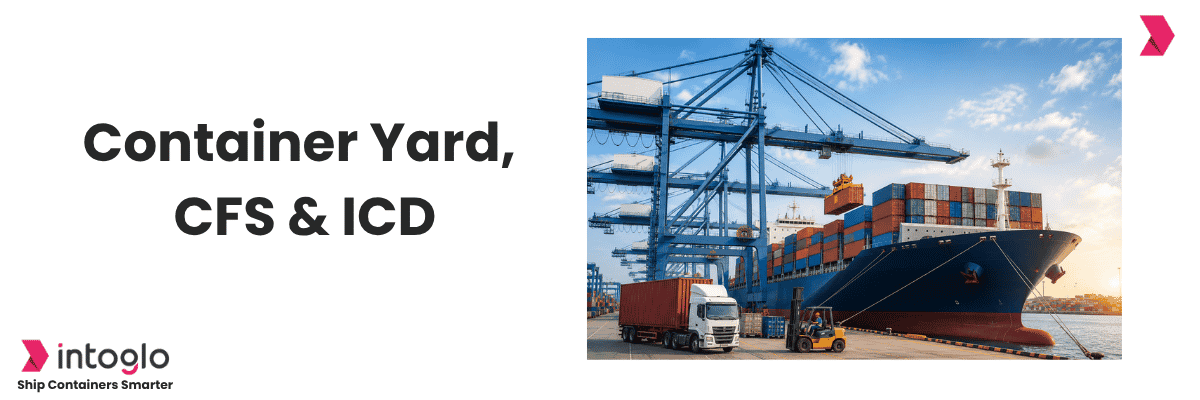
A Container Yard (CY) serves as a designated area within or near a port where port operators temporarily store containers before loading them onto a vessel or after unloading them.
Port operators use container yards to store, stack, move, and dispatch full containers within port terminals. Shipping lines and terminal operators rely on CYs to manage container flow efficiently and support smooth vessel operations.
If you want a deeper understanding of Container Yard? Read Container Yard in Shipping: Complete Guide for Exporters.
What is a Container Freight Station?
A Container Freight Station (CFS) consolidates export cargo into containers and deconsolidates imported cargo after arrival.
CFS operators primarily handle Less than Container Load (LCL) shipments by combining cargo from multiple shippers into a single container. They also perform selected Full Container Load (FCL) activities, including customs inspections, cargo stuffing, de-stuffing, documentation processing, and temporary cargo storage.
What is an Inland Container Depot?
An Inland Container Depot (ICD) is a dry port located away from seaports that provides container handling, storage, and customs clearance services.
Inland Container Depots (ICDs) enable exporters and importers to complete customs procedures closer to their business locations. Many ICDs connect to seaports through rail networks, allowing operators to move containers efficiently and reduce congestion at major ports
Container Yard, CFS, and ICD: Comparison

Although these facilities are connected to container logistics, their functions differ significantly.
| Feature | Container Yard (CY) | CFS | ICD |
| Primary Purpose | Container storage and handling | Cargo consolidation and deconsolidation | Inland container handling and customs clearance |
| Location | Port or terminal area | Near ports | Inland locations |
| Cargo Type | Primarily FCL | Primarily LCL | FCL and LCL |
| Customs Services | Limited | Limited | Full customs clearance |
| Container Storage | Yes | Limited | Yes |
| Cargo Consolidation | No | Yes | Limited |
| Main Users | Shipping lines and terminals | Freight forwarders and consolidators | Exporters and importers |
How Do These Facilities Work Together?
These facilities often operate as part of the same logistics chain.
FCL Export Flow
Factory → Port/ICD (if required) → Container Yard → Vessel
For FCL shipments, exporters load cargo into a container at the factory. The container may pass through an ICD for customs clearance before reaching the port. The Container Yard (CY) stores the container until vessel loading.
LCL Export Flow
Factory → CFS → Container Yard → Vessel
For LCL shipments, a CFS consolidates cargo from multiple exporters into a single container. The container then moves to the Container Yard (CY) for storage before vessel loading.
Which Facility Should Exporters Use?
The right facility depends on shipment type and logistics requirements.
| Situation | Recommended Facility |
| FCL Export Shipment | Container Yard |
| LCL Export Shipment | CFS |
| Inland Customs Clearance | ICD |
| Rail-Based Container Movement | ICD |
| Cargo Consolidation | CFS |
How Intoglo Supports Export Logistics?
Managing container movement across multiple logistics facilities can be complex.
Intoglo provides end-to-end digital FCL forwarding from India to the USA, helping exporters coordinate container transportation, customs processes, shipment tracking, and destination delivery through a single platform.
By integrating shipping lines, customs brokers, and transportation partners, Intoglo helps businesses streamline export operations and improve shipment visibility.
Need help with India-USA container shipping? Contact Intoglo:
📩 contact@intoglo.com | 📞 +91 84697 08714
Conclusion
Container Yards, CFS facilities, and ICDs each perform a distinct role in international logistics. Container Yards focus on container storage and handling at ports, CFS facilities manage cargo consolidation and related handling activities, and ICDs provide inland customs and container services. Understanding the differences between these facilities helps exporters choose the right logistics route and improve shipment efficiency.
FAQs
What is the difference between a Container Yard and a CFS?
A Container Yard stores and handles containers, while a CFS consolidates or deconsolidates cargo and supports various cargo-handling activities.
Is an ICD the same as a dry port?
Yes, an ICD is commonly referred to as a dry port because it provides customs and container services away from seaports.
Which facility is primarily used for LCL shipments?
CFS facilities are primarily used for LCL cargo because they support the consolidation and deconsolidation of shipments from multiple shippers.
Can a CFS handle FCL cargo?
Yes, while CFS facilities are mainly associated with LCL shipments, they may also handle certain FCL activities such as customs examination, stuffing, de-stuffing, and temporary storage.
Why do exporters use ICDs?
ICDs provide customs clearance, container handling, and transportation services closer to manufacturing and industrial areas, reducing the need to process shipments directly at seaports.