Quick Overview
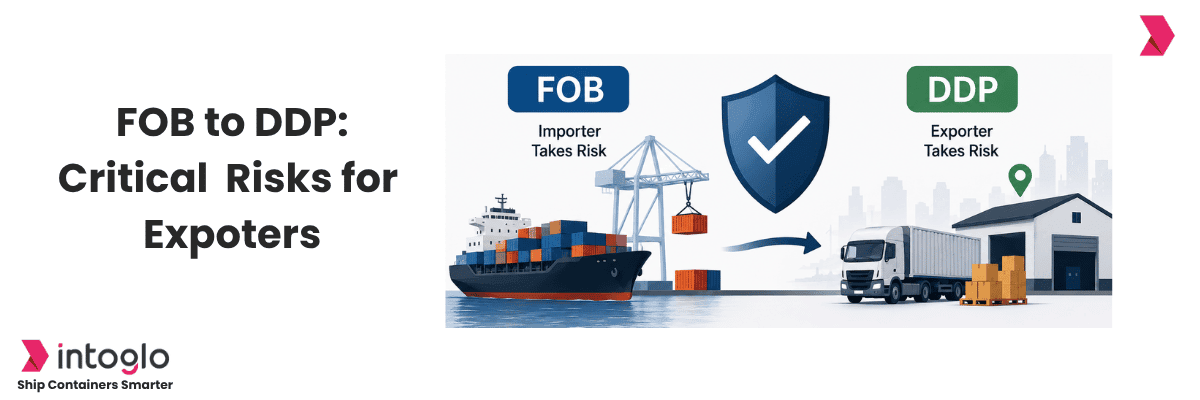
FOB (Free on Board) and DDP (Delivered Duty Paid) are international shipping terms that define responsibility for a shipment. Under FOB, the importer is responsible for import clearance, duties, and final delivery after the cargo is loaded onto the vessel. Under DDP, the exporter is responsible for freight, customs clearance, duties, taxes, and delivery to the buyer's location. As a result, DDP transfers significant responsibilities and risks from the buyer to the seller.
Before offering DDP shipments, exporters should understand the major risks involved:
- Duty and tax liability shift to the exporter.
- Customs compliance errors can delay shipments.
- Port storage and demurrage costs can increase unexpectedly.
- Freight and transportation costs may fluctuate.
- Limited last-mile visibility can affect customer satisfaction.
Understanding the risks is important, but so is knowing how to implement DDP successfully. Read How Indian Exporters Can Move from FOB to DDP Shipments to learn how exporters can prepare for a smooth transition.
Understanding the Risk Difference Between FOB & DDP
Under FOB (Free on Board), the importer is responsible for import customs clearance, duties, destination transportation, and final delivery after the cargo is loaded onto the vessel.
Under DDP (Delivered Duty Paid), the exporter is responsible for freight, import customs clearance, duties, taxes, and delivery to the importer's location.
As a result, DDP exposes exporters to greater financial and operational risk.
| Aspect | FOB | DDP |
| Import Duties & Taxes Risk | Importer | Exporter |
| Customs Compliance Risk | Importer | Exporter |
| Storage & Demurrage Risk | Importer | Exporter |
| Freight Costs | Importer | Exporter |
| Last-Mile Delivery Risk | Importer | Exporter |
| Pricing Complexity | Lower | Higher |
Understanding these responsibilities helps exporters identify the risks they must manage before offering DDP shipments.
5 Critical Risks Indian Exporters Must Manage Under DDP

As responsibility shifts from the importer to the exporter under DDP, businesses must manage several financial, compliance, and delivery-related risks.
1. Duty & Tax Liability Risk
Under DDP, the exporter is responsible for import duties, taxes, and other destination charges.
Key Risks:
- Incorrect duty calculations.
- Tariff changes after quotation.
- Unexpected import charges.
- Reduced profit margins.
Even small errors in duty calculations can increase landed costs and reduce shipment profitability.
How to Reduce the Risk:
- Verify HS classifications before quoting.
- Review applicable duties and taxes.
- Include contingency margins in pricing.
- Monitor tariff changes regularly.
2. Customs Compliance Risk
Under DDP, exporters are responsible for ensuring shipments meet destination-country import requirements.
Key Risks:
- Incorrect HS codes.
- Missing documentation.
- Country-of-origin declaration errors.
- Product-specific compliance violations.
Compliance issues can lead to inspections, shipment holds, penalties, and customs delays.
How to Reduce the Risk:
- Review shipping documents before dispatch.
- Work with experienced customs brokers.
- Maintain updated product classifications.
- Monitor regulatory changes.
3. Port Storage & Demurrage Risk
Delays in customs clearance can result in additional charges at the destination port.
Key Risks:
- Demurrage charges.
- Detention fees.
- Port storage costs.
- Terminal handling surcharges.
These costs can quickly increase the total landed cost of a shipment.
How to Reduce the Risk:
- Prepare customs documents before cargo arrival.
- Coordinate with destination customs brokers.
- Track shipment milestones closely.
- Respond quickly to customs queries.
4. Freight & Transportation Cost Risk
Under DDP, exporters assume responsibility for international and domestic transportation costs.
Key Risks:
- Ocean freight fluctuations.
- Trucking rate increases.
- Fuel surcharges.
- Peak-season capacity shortages.
Changes in transportation costs can reduce margins if DDP pricing is not updated regularly.
How to Reduce the Risk:
- Negotiate contract rates where possible.
- Review freight costs regularly.
- Update pricing models frequently.
- Monitor transportation market trends.
5. Last-Mile Delivery Visibility Risk
The exporter remains responsible until the shipment reaches the importer's location.
Key Risks:
- Delivery scheduling issues.
- Limited shipment visibility.
- Communication gaps.
- Missed delivery appointments.
Poor last-mile execution can lead to delivery delays and customer dissatisfaction.
How to Reduce the Risk:
- Use transportation partners with tracking capabilities.
- Establish delivery communication processes.
- Monitor delivery milestones.
- Share shipment updates with importers.
DDP Risk Matrix for Exporters
Not all DDP risks have the same impact. The table below highlights the areas that typically require the most attention from exporters.
| Risk | Likelihood | Financial Impact |
| Duty & Tax Miscalculation | High | High |
| Customs Compliance Errors | Medium | High |
| Storage & Demurrage Charges | Medium | High |
| Freight Cost Volatility | High | Medium |
| Last-Mile Delivery Delays | High | Medium |
This risk matrix helps exporters prioritize areas that require stronger controls before scaling DDP operations.
How Intoglo Helps Exporters Manage DDP Risks
DDP shipments require coordination across freight transportation, customs clearance, and destination delivery.
Intoglo provides end-to-end FCL forwarding for shipments from India to the USA, helping exporters manage transportation, customs clearance, shipment tracking, and door-to-door delivery through a single platform.
Intoglo offers instant freight quotes, real-time shipment visibility, and delivery coverage across 41,000+ USA ZIP codes. It supports a range of export categories, including auto parts, chemicals, paper and packaging products, and pharmaceuticals.
By integrating freight, customs clearance, and destination delivery services, Intoglo helps exporters improve shipment visibility and manage DDP operations more efficiently.
Need help with smooth India-USA shipping? Contact Intoglo:
📩 contact@intoglo.com | 📞 +91 84697 08714
Conclusion
DDP shipments offer exporters greater control over the customer experience but also increase responsibility for duties, compliance, transportation, and delivery. Risks such as duty miscalculations, customs delays, storage charges, freight fluctuations, and last-mile issues can affect profitability. Managing these risks through proper planning and reliable logistics support is essential for successful DDP operations.
FAQs
What is the biggest risk of DDP shipping?
Duty and tax liability is often the biggest risk because exporters become responsible for import charges that the buyer previously handled.
Why are customs compliance issues more important under DDP?
Under DDP, the exporter is responsible for ensuring the shipment meets destination-country import requirements, making compliance errors more costly.
What are demurrage and storage charges?
These are fees that may be charged when cargo remains at a port or terminal beyond the allowed free time.
How can exporters reduce DDP shipping risks?
Accurate landed cost calculations, customs compliance reviews, strong logistics partnerships, and shipment visibility tools help reduce risk.
Should all exporters offer DDP?
Not necessarily. Exporters should evaluate their ability to manage customs clearance, duties, transportation costs, and destination delivery before offering DDP services.