
Quick Overview
Choosing between FCL vs LCL can have a significant impact on the cost, transit time, and handling of an India-USA shipment. FCL gives exporters dedicated use of a container, while LCL combines smaller shipments from multiple exporters. The right option depends on cargo volume, total landed cost, delivery timelines, cargo characteristics, and shipment frequency.
Key Facts About FCL vs LCL:
- FCL gives one shipper dedicated use of the container.
- LCL combines cargo from multiple shippers in one container.
- LCL is generally more suitable for smaller shipments.
- Around 12–15 CBM, exporters should compare both options.
- FCL usually involves less cargo handling than LCL.
- LCL can add consolidation and deconsolidation time.
- Ocean transit from India to the USA varies by port, routing, and carrier schedule.
What Is FCL Shipping?
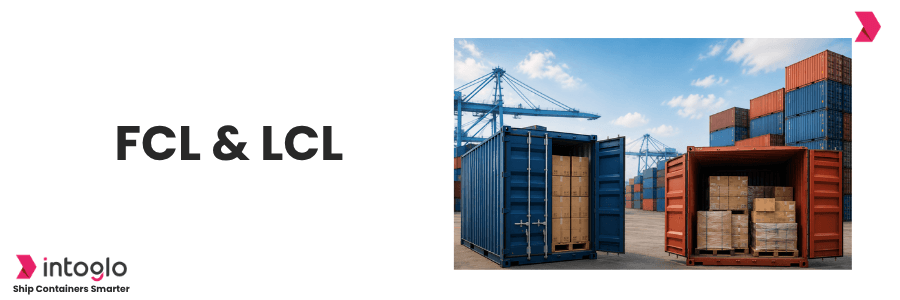
FCL stands for Full Container Load. The exporter books an entire 20-foot or 40-foot container, but it does not need to be completely full. The container is stuffed, sealed, shipped, and opened at destination, reducing handling during transit. For regular USA exports, FCL can also offer better cost efficiency as container utilization increases.
What Is LCL Shipping?
LCL stands for Less than Container Load. so, instead of booking an entire container, the exporter pays for the portion of container space used by their cargo. Multiple shipments are consolidated into the same container.
The forwarder or consolidator handles the consolidation at origin and deconsolidation at destination which makes LCL useful when an exporter has a small shipment and does not want to pay for an entire container.

FCL vs LCL: What Is the Difference?
| Factor | FCL | LCL |
| Container use | Dedicated container | Shared container |
| Best suited for | Larger shipments | Smaller shipments |
| Pricing basis | Container | Cargo volume/weight |
| Cargo handling | Lower | Higher |
| Consolidation | Not required | Required |
| Transit time | Usually faster | Usually longer |
| Cargo control | Higher | Lower |
| Typical use | Regular commercial exports | Smaller or occasional shipments |
The important point is that LCL is not automatically cheaper.
A shipment may occupy less than a full container but still become more expensive through LCL handling, CFS charges, documentation, consolidation, deconsolidation, and other origin or destination fees.
When Does LCL Make More Sense?
LCL can make sense when:
- Your shipment occupies only a small amount of container space.
- You export occasionally rather than every week or month.
- You are testing a new US market.
- Your cargo does not justify booking a full container.
- You prefer a lower initial freight commitment.
For example, a manufacturer shipping 5 CBM of samples or a small commercial order may not benefit from booking an entire 20-foot container.
In such cases, LCL allows the exporter to move the cargo without waiting to accumulate enough volume for FCL.
When Does FCL Make More Sense?
FCL becomes more attractive when:
- Your shipment approaches the LCL/FCL break-even point.
- You regularly export to the USA.
- Your cargo is fragile, high-value, or difficult to handle.
- You want greater control over the container.
- You need a more predictable cargo flow.
- You want to reduce consolidation-related handling.
FCL also becomes particularly useful when shipment volumes are predictable.
Instead of repeatedly comparing small LCL shipments, exporters can establish regular FCL booking schedules and plan inventory around them.
How Does Handling Differ Between FCL and LCL?
FCL offers greater control because the cargo passes through fewer handling stages. LCL involves consolidation and deconsolidation, which means additional loading and unloading.
LCL is not inherently less safe, but exporters shipping fragile, high-value, or damage-prone cargo should consider the additional handling when comparing both options.
How to Compare FCL and LCL Quotes?
Do not compare only the headline ocean freight.
Ask your forwarder for a complete cost comparison covering:
- Origin charges
- Ocean freight
- CFS or consolidation charges
- Documentation fees
- Destination handling
- Customs clearance
- Delivery or drayage
- Potential storage charges
- Other carrier or terminal fees
This gives you the true landed logistics cost, rather than comparing two incomplete freight rates.
How Does Customs Affect FCL and LCL?
Choosing FCL or LCL does not change the need to meet US import requirements. Importers must provide accurate information for customs clearance, including tariff classification and applicable duties.
CBP states that importers remains responsible for compliance, even when a customs broker handles the entry. Therefore, exporters and US buyers should keep invoices, packing lists, shipping documents, product descriptions, and tariff classifications consistent.
Before shipping, review the latest requirements from U.S. Customs and Border Protection.
A Simple Decision Rule for Exporters
Use shipment volume and cargo characteristics as a starting point, but compare the total landed cost before booking.
- Under 10 CBM: LCL is often worth considering for smaller shipments.
- 10–15 CBM: Compare both FCL and LCL quotes, as freight and local charges can change the better option.
- Above 15 CBM: FCL often becomes more attractive, especially for regular shipments.
- Fragile or high-value cargo: FCL may be preferable because it involves fewer consolidation and handling stages.
How Intoglo Helps
Intoglo helps Indian exporters evaluate India-USA FCL shipments based on cargo volume, routing, freight costs, documentation, customs coordination, and US inland delivery requirements.
Planning your next shipment to the USA? Get a quote from Intoglo.
Stay informed about carrier announcements, freight rates, and trade regulations by joining our free 30-minute monthly India-USA Trade Pulse webinar.
📩 contact@intoglo.com 📞 +91 84697 08714
Conclusion
For India-USA exports, LCL generally makes sense for smaller shipments, while FCL becomes increasingly attractive as volume approaches 12–15 CBM. However, exporters should compare total landed costs because CFS, destination, handling, and delivery charges can change the economics.
Before booking, ask for both FCL and LCL quotes whenever your shipment is near the break-even range. That simple comparison can prevent you from choosing the cheaper-looking option that ultimately costs more.
FAQs
Is FCL cheaper than LCL for India-USA exports?
Not always. LCL can cost less for small shipments, while FCL often becomes more economical as shipment volume increases. Compare the complete landed cost rather than the ocean freight rate alone.
What is the FCL vs LCL break-even point?
A practical comparison range is around 12–15 CBM, but the actual break-even point varies with freight rates, CFS charges, destination fees, and routing.
Is LCL slower than FCL?
It can be. LCL requires consolidation and deconsolidation, which can add handling and transit time compared with a dedicated FCL container.
Should I choose FCL for fragile cargo?
FCL can be preferable for fragile or high-value cargo because the shipment generally passes through fewer consolidation and deconsolidation stages.
Can I book FCL if my container is not full?
Yes. FCL means you have dedicated use of the container; it does not require you to fill every cubic meter.
Is LCL suitable for regular India-USA exports?
It can be, particularly for consistently small shipments. However, exporters shipping regularly should periodically compare LCL costs against FCL because their volume may justify moving to dedicated containers.
Does FCL or LCL affect US customs duty?
The shipment mode itself does not determine the applicable duty rate. US duty depends on factors such as tariff classification, customs value, and origin. CBP requires importers to provide accurate classification and duty information.