Quick Overview
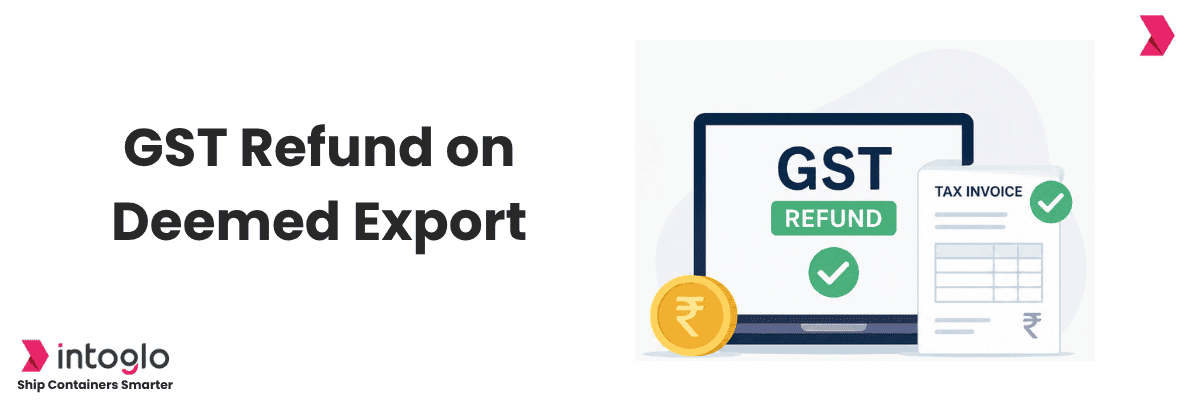
Deemed exports under GST refer to supplies where goods are treated as exports for tax benefits, even though they do not leave India. This mechanism ensures that, in most cases, the effective GST burden becomes zero once the refund is successfully processed, provided all compliance conditions are met.
Here are the key points about deemed export GST refunds:
- The supplier charges and pays applicable GST while making the supply to eligible units like EOUs, EHTPs, STPs, or BTPs.
- Either the supplier or the recipient unit can claim the refund, but not both for the same transaction.
- The GST paid is later claimed as a refund by filing Form RFD-01 on the GST portal.
- Supporting documents, such as invoice-wise statements and declarations, must be submitted with the refund application.
- Accurate reporting in GSTR-1 and GSTR-3B is mandatory to avoid mismatch-related delays.
If you want to understand the types of transactions covered under deemed exports and who can benefit, read our article: What Are Deemed Exports in GST & Who Can Claim Refund?
How GST Works in Deemed Exports at the Time of Supply?
Unlike zero-rated exports, deemed exports require you to pay the applicable GST rate at the point of supply.
1. You supply goods to an Export Oriented Unit (EOU) or an Advance Authorization (AA) holder.
2. You issue the tax invoice with the applicable GST charged on the supply.
3. You pay the applicable GST to the government.
4. You then apply for a refund of the GST paid through the GST portal.
In most deemed export transactions, the refund brings your effective GST rate to 0%. There are limited exceptions where a nominal rate may apply - a tax advisor can confirm the exact rate for your category.
Who Can Claim the Refund?
Refund eligibility depends on who files the claim for the transaction.
- Suppliers: If the supplier made the deemed export supply and paid GST, they are generally the primary claimant for the refund
- Recipient units (EOUs, EHTPs, STPs, BTPs): In specific scenarios, the recipient unit can claim the refund instead. If the recipient claims it, they must declare they have not claimed Input Tax Credit (ITC) on the same transaction.
Important: Only one party can claim the refund for a deemed export transaction. Suppliers and recipient units should coordinate before filing the application.
Mandatory Form A Process Before Deemed Export Supply
For supplies made to EOUs, EHTPs, STPs, or BTPs, Form A must be completed before the supply takes place.
- The recipient unit submits Form A to notify the supplier and GST authorities that the goods are being procured under deemed export benefits.
- The form must be approved by the Development Commissioner before the transaction proceeds.
Failure to complete this process can affect refund eligibility.
How Suppliers Can Claim GST Refund?

When a supplier makes a deemed export supply and pays GST on it, there is a specific claim process to recover that tax.
1. Supply the goods and issue a tax invoice to the recipient unit, including the applicable GST amount.
2. Get the recipient unit to endorse your tax invoice, confirming receipt of goods.
3. Report the transaction correctly in GSTR-1 (outward supplies) and GSTR-3B (summary return) for that month.
4. File Form RFD-01 electronically on the GST portal, with details of all deemed export supplies and tax paid.
5. Attach supporting documents: endorsed invoice, invoice-wise breakdown statement, and any acknowledgment from the recipient unit's tax officer.
6. Submit and track your application through the GST portal.
Documents You Need to File the Refund
To avoid rejection or delays, you must upload the correct supporting documents while filing Form RFD-01 on the GST portal.
- Form RFD-01 refund application.
- Invoice-wise statement of deemed export supplies (Statement 5B).
- GST tax invoices are issued to the recipient unit.
- Endorsed invoices confirming receipt of goods.
- Acknowledgment from the recipient unit’s GST officer, where applicable.
- Recipient declaration confirming ITC has not been claimed.
- Supplier declaration regarding refund eligibility.
- GSTR-1 and GSTR-3B filing details.
This list covers the key documents generally required so that no important document is missed.
GST Return Compliance for Deemed Exports
GST return accuracy plays a major role in refund approval.
- GSTR-1 should correctly report invoice details, GSTIN, and HSN information.
- GSTR-3B should declare the GST liability paid on these supplies and report ITC correctly (if applicable).
Any mismatch, delay, or missing return can lead to refund objections or delays.
Conclusion
The GST refund process for deemed exports becomes much smoother when documentation, invoice endorsements, and GST returns are handled correctly from the beginning. Filing Form RFD-01 accurately and maintaining proper compliance can help businesses recover GST efficiently and improve working capital.
Planning to ship goods from India to the USA? Intoglo offers end-to-end logistics support, including pickup, export clearance, ocean freight, and US-side coordination.
For smooth India–USA shipping, contact Intoglo.
📩 contact@intoglo.com | 📞 +91 84697 08714
FAQs
How long does it take to receive a GST refund on deemed exports?
The GST portal typically processes refund applications within 60 days of a complete filing. Delays occur when documentation is incomplete or when GSTR filings do not match the refund application.
Can I file a manual refund application instead of online?
Online filing through the GST portal is mandatory in most cases and strongly recommended. Manual applications are permitted only in exceptional circumstances and usually result in much longer processing times.
What happens if both the recipient unit and supplier file for a refund on the same transaction?
Only one party can claim the refund. If both file, the claim will be rejected for one or both parties. Coordinate with your recipient unit before filing.
Is the refund process different for gold supplied by banks against an Advance Authorization?
General CGST refund rules apply, but gold-specific documentation and AA requirements must be carefully followed. Consult a tax advisor with experience in the gold export space.