Quick Overview
Wharfage is a port charge paid for using terminal infrastructure when cargo is loaded or unloaded at a port.
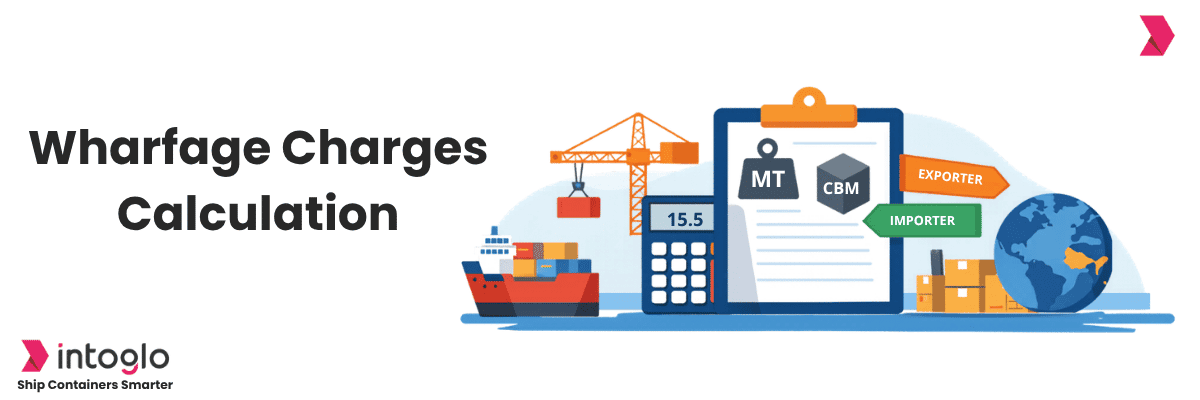
- It is calculated based on whichever is higher between cargo weight (MT) or volume (CBM); this is known as revenue ton.
- Wharfage is usually included in Terminal Handling Charges (THC), not shown separately. To confirm the amount, ask your freight forwarder for a THC breakdown.
- Who pays wharfage depends on the Incoterm - it may be paid by the exporter at origin or the importer at destination, based on the contract terms.
Want to understand what wharfage means and why ports charge it? Read our article, “What Are Wharfage Charges? A Complete Guide for Exporters,” before diving into calculations and Incoterms responsibilities.
How Wharfage Is Calculated?
The key concept is the revenue ton. Port authorities charge based on whichever is greater:
- Weight: Measured in metric tonnes (MT).
- Volume: Measured in cubic metres (CBM).
This protects the port from undercharging on light-but-bulky cargo. For example, a container of foam packaging is light but takes up significant space. The revenue ton ensures the port is fairly compensated.
Calculation formula:
Revenue Tons = MAX (Weight in MT, Volume in CBM)
Wharfage due = Revenue Tons × Rate per ton (set by port authority)
For containerized cargo, it is simpler- charges are usually flat per container size (per TEU or FEU). Port authorities publish these rates annually.
Where Does Wharfage Appear on Your Invoice?
Wharfage rarely appears as a standalone line item. Shipping lines fold it into Terminal Handling Charges (THC). As an exporter, you see one consolidated THC figure.
Port authorities, however, bill shipping lines directly using published tariff sheets. If you want to verify, ask your freight forwarder for the THC breakdown. A good forwarder will be transparent about this.
Who Pays Wharfage Under Incoterms?
Incoterms define exactly where the exporter's responsibility ends and where the importer’s responsibility begins. Since wharfage is a port-based charge, the Incoterm used in your shipment contract determines whether it is paid by the exporter or the importer.
| Incoterm | Who Pays Wharfage at Origin? | Who Pays Wharfage at Destination? |
| EXW | Importer | Importer |
| FCA | Importer | Importer |
| FOB | Exporter | Importer |
| CFR / CIF | Exporter | Importer |
| DPU / DDP | Exporter | Exporter |
Most Indian exporters shipping to the USA operate on FOB terms, meaning the exporter pays wharfage at the origin port (such as JNPT or Mundra), while the US buyer pays destination wharfage and other import-side terminal charges.
Key Differences Between Wharfage, Demurrage, Arrastre, & Dockage

Wharfage, demurrage, arrastre, and dockage are separate port charges, each applied for a different reason.
- Wharfage is charged for cargo movement through the port terminal and is calculated on revenue tons (weight or volume, whichever is higher). It applies to most shipments.
- Demurrage is a penalty charged when containers are not cleared or returned within the free period. It is calculated by days and is avoidable.
- Arrastre covers cargo handling services inside the terminal, including the shifting and movement of cargo. It is usually included in terminal handling costs.
- Dockage is charged for the vessel using the dock or berth space while it is moored at the port.
At Intoglo, we handle FCL shipments from India to the USA with no hidden fees. We provide a clear cost breakdown upfront, and you can download our updated sailing schedule to plan shipments with accurate cut-off dates and ETD/ETA timelines.
Need support with your shipment? Contact Intoglo.
📩 contact@intoglo.com | 📞 +91 84697 08714
Conclusion
Wharfage is calculated on revenue tons, appears within your THC, and is assigned by Incoterm. It is not the same as demurrage, arrastre, or dockage; each covers a different part of the port process. Knowing the difference helps you read your shipping documents accurately and negotiate with confidence.
FAQs
How do I calculate wharfage for my export shipment?
Take the greater of cargo weight (in MT) or volume (in CBM). Multiply by the port's published rate. For containerised cargo, it is usually a flat rate per TEU or FEU.
Can wharfage be negotiated?
Port authority wharfage rates are fixed and non-negotiable. However, your freight forwarder may be able to consolidate THC charges in a way that offers better overall pricing.
Is wharfage charged on both inbound and outbound shipments?
Yes, wharfage applies whenever cargo moves through a port - on export at origin and on import at destination. It is a standard global practice.
Is wharfage included in Terminal Handling Charges (THC)?
Yes, in most cases, wharfage is bundled inside THC and does not appear as a separate line item. The port bills the shipping line, and the shipping line passes it through in THC
Do all Indian ports charge the same wharfage rates?
No, wharfage rates differ by port authority, cargo category, and tariff schedule. JNPT, Mundra, Chennai, and other ports publish different wharfage rate structures.
What is the difference between wharfage and storage charges?
Wharfage is a mandatory charge for cargo movement through the port, while storage charges apply only if your cargo stays at the port beyond the free storage period.