Quick Overview
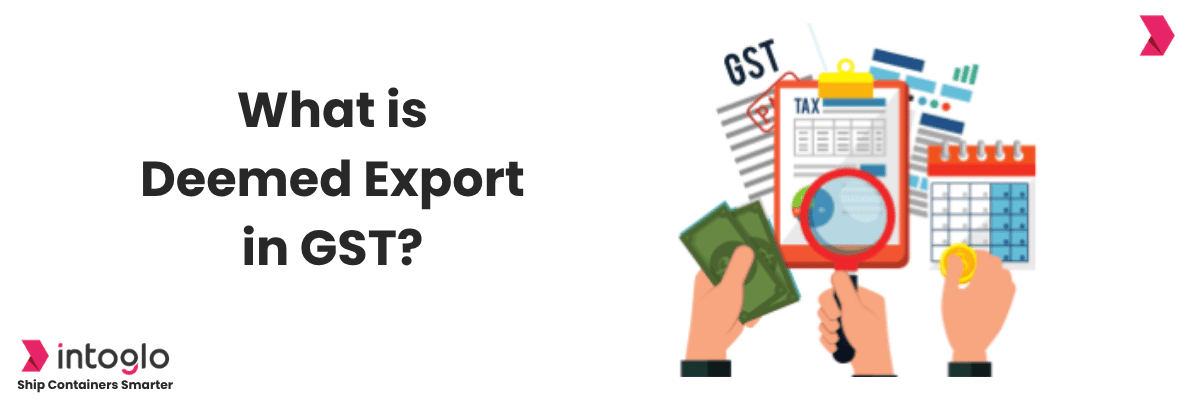
Deemed exports are certain domestic supplies under GST where goods do not leave India, but the supply is still treated as export-equivalent for tax benefits. This allows eligible suppliers or recipients to claim GST refund benefits, even though the transaction happens within India.
Key points to understand:
- Deemed exports apply only to notified categories such as EOUs, Advance Authorization (AA) holders, and EPCG units.
- Goods must be manufactured in India; simple trading or resale does not qualify.
- GST is charged and paid at the time of supply, and later claimed as a refund.
- Deemed export benefits apply only to goods, not services.
This basic structure helps you understand what deemed exports are before diving deeper into eligibility, differences, and refund rules.
What Are Deemed Exports?
Deemed exports are supplies of specific goods manufactured in India where the goods do not physically leave the country, yet the transaction is treated as an export for GST purposes.
This is defined under Section 147 of the Central Goods and Services Tax (CGST) Act, where the Central Government notifies the specific goods and supply categories that qualify. Deemed export benefits apply only to goods, not services.
In simple terms, the goods remain within India, but the supply is recognised as export-equivalent, allowing eligible businesses to claim GST-related benefits.
How Deemed Exports Differ from Regular Exports?

Deemed exports and regular exports may seem similar because both offer GST benefits. However, the key difference is whether the goods leave India and how the refund is claimed.
| Basis | Regular (Zero-Rated) Exports | Deemed Exports |
| Movement of goods | Goods are exported outside India. | Goods remain within India. |
| GST treatment | Treated as a zero-rated supply. | Treated as export-equivalent supply. |
| GST is charged on the supply | Not charged (if supplied under LUT/bond). | Charged and paid at the time of supply. |
| Refund process | An ITC refund can be claimed without paying GST upfront | GST refund is claimed after payment (by supplier or recipient). |
| LUT/Bond allowed | Yes | No |
| Documentation focus | Shipping bill and export documents. | GST invoice + deemed export declarations and approvals |
Who Qualifies for Deemed Export Benefits?
Your supply must fall under Notification No. 48/2017 - Central Tax (as amended). The key qualifying categories are:
- Advance Authorization (AA) holders: Companies with an AA license import inputs duty-free for export production. Supplying goods to them qualifies as a deemed export.
- EPCG Authorization holders: The Export Promotion Capital Goods scheme lets businesses import capital goods at concessional duty. Supplying such goods to EPCG holders qualifies.
- Export-Oriented Units (EOUs) and similar setups: Includes EOUs, Software Technology Parks (STPs), Electronic Hardware Technology Parks (EHTPs), and Bio-Technology Parks (BTPs). Supplying goods to these units counts as a deemed export.
- Gold supplied by Banks or PSUs against AA: When a bank or public sector undertaking provides gold against an Advance Authorization, that transaction is treated as a deemed export.
Conditions to Qualify for Deemed Exports
Even if your buyer is eligible (EOU, AA holder, EPCG unit, etc.), your supply will be treated as a deemed export only if you meet these mandatory conditions under GST:
1. Your goods must be manufactured or produced in India. Traded goods do not qualify.
2. Payment can be received in Indian Rupees (INR) or any convertible foreign currency.
3. The supply cannot be made under a LUT or bond. You must pay GST at the time of supply.
Key Benefits for Indian Manufacturers
Deemed exports offer real financial advantages for manufacturers supplying to export-linked buyers, helping reduce tax costs while improving competitiveness.
- Cash flow relief: You pay GST at the time of supply but recover it fully through the refund mechanism, making your effective GST cost close to zero.
- Global competitiveness: Lower input costs make your products price-competitive against foreign suppliers in international tenders.
- Supports domestic manufacturing: The scheme keeps production in India while connecting it to global supply chains.
- Flexible payment terms: Accepting payment in foreign currency is allowed, making it easier to deal with international buyers.
For manufacturers supplying to EOUs or AA holders, logistics documentation must align with GST compliance to avoid refund delays.
If you want to ship from India to the USA, Intoglo can support your door-to-door India–USA FCL shipping requirements. We also provide updated sailing schedules, transparent freight visibility, and clarity on shipping costs to help exporters plan better.
To get ocean freight support for the India - USA shipment, reach out to Intoglo.
📩 contact@intoglo.com | 📞 +91 84697 08714
Conclusion
Deemed exports are one of the most overlooked benefits under India’s GST system. If you manufacture goods and supply to export-linked buyers, EOUs, AA holders, or EPCG units, you may qualify for refund benefits. Understanding the rules can help you reduce GST costs and stay competitive in global trade.
FAQs
Can I claim deemed export benefits if I am a trader, not a manufacturer?
No, deemed exports apply only to goods manufactured or produced in India. Trading firms that source and resell goods without manufacturing do not qualify.
Is GST registration mandatory to claim deemed export benefits?
Yes, both the supplier and the recipient unit must be registered under GST. Without registration, the refund claim cannot be processed.
Can deemed export benefits apply to services?
No, under Section 147 of the CGST Act, deemed exports apply exclusively to goods. Service providers are not eligible for this scheme.
What is the practical difference between deemed exports and zero-rated exports?
In zero-rated exports, no GST is charged upfront - you supply under LUT. In deemed exports, GST is paid at the point of supply and then reclaimed as a refund. Both result in zero effective GST, but the process and documentation differ significantly.