
Quick Overview
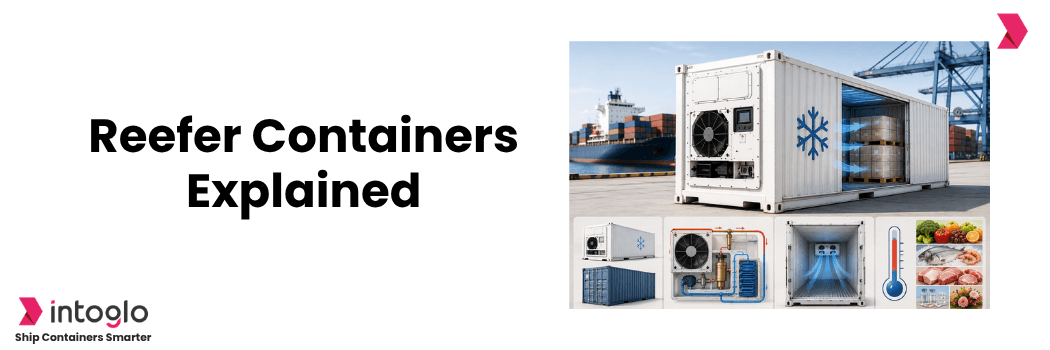
A reefer container, short for refrigerated container, is an insulated shipping container with an integrated refrigeration unit that keeps temperature-sensitive cargo within a controlled temperature range during ocean, road, and rail transportation.
Reefer containers are commonly used for fresh produce, frozen foods, seafood, pharmaceuticals, dairy products, meat, flowers, and other temperature-sensitive goods. Unlike standard dry containers, reefers continuously manage temperature, airflow, and ventilation throughout transit.
Key Facts about reefer containers at a glance:
- Reefer containers are commonly available in 20-foot and 40-foot sizes.
- They use an integrated refrigeration unit to maintain the required cargo temperature.
- Typical applications include food, pharmaceuticals, seafood, meat, dairy, and fresh produce.
- Reefers can support both chilled and frozen cargo, depending on the equipment specification.
- Cargo must be pre-cooled when required because a reefer is designed primarily to maintain temperature.
- Reefer freight costs are generally higher than dry-container freight.
- Proper temperature settings, ventilation, airflow, and monitoring are critical to prevent cargo damage.
Reefer Container Sizes
The two most common ocean-freight options are 20-foot standard reefers and 40-foot High Cube reefers.
| Reefer Type | Approx. Capacity | Typical Use |
| 20' Standard Reefer | 28.3 m³ | Smaller temperature-sensitive shipments |
| 40' High Cube Reefer | 67.5 m³ | Larger commercial shipments |
| 40' High Cube Super Freezer | Up to 86 m³* | Deep-frozen cargo |
*Capacity varies by equipment specification. Always confirm the exact unit available from the carrier.
A reefer generally has less usable internal space than a dry container of the same nominal size because the refrigeration machinery takes up part of the container.

Critical Considerations for Reefer Cargo
Before booking, exporters should confirm the required temperature, ventilation, pre-cooling, and cargo loading requirements for their product.
Cargo should be loaded at the appropriate transport temperature and positioned to allow proper airflow. Incorrect loading or blocked air passages can create temperature variations and damage the cargo.
For India-USA shipments, exporters should also account for port dwell time, customs clearance, vessel transit, and inland delivery when planning a reefer shipment.
Reefer Container Temperature Range
The required temperature depends entirely on the cargo.For example, a carrier may offer standard reefers with operating ranges around -30°C to +30°C, while specialized super-freezer equipment can operate at much lower temperatures.
However, exporters should not select a reefer simply based on its maximum temperature range.
The cargo's required transport temperature, pre-cooling requirement, ventilation setting, and acceptable temperature variation should determine the equipment choice.
Factors That Affect Reefer Shipping Rates
Ocean freight: Reefer rates are usually higher because carriers incur additional equipment, energy, and handling costs.
Port and terminal charges: Reefer cargo can attract additional terminal and monitoring charges.
Electricity and monitoring: Reefers need continuous power while connected at terminals, creating additional operating costs.
Destination services: Drayage, storage, inspections, and delivery requirements can increase the total landed cost.
Seasonality: Agricultural seasons and peak demand can significantly affect reefer equipment availability and pricing.
A brand new refrigerated (reefer) container generally costs between $28,000 and $48,000, while used reefer containers typically cost between $9,000 and $22,000, depending heavily on size, condition, and the refrigeration unit manufacturer.
What Should Exporters Check Before Booking?
Before booking, exporters should confirm:
- The required temperature range.
- Whether the cargo needs ventilation.
- Whether the cargo must be pre-cooled.
- Packaging and airflow requirements.
- Reefer plug availability at origin and destination.
- Carrier-specific reefer acceptance requirements.
- Temperature control and documentation requirements.
- Emergency procedures in case of equipment failure.
Temperature-sensitive cargo also needs careful planning around customs clearance and inland transportation because delays can increase the risk of product deterioration.
For general container loading and securing practices, exporters can refer to the IMO/ILO/UNECE CTU Code.
Reefer vs Dry Container: Which Should You Use?
The decision depends on whether the cargo needs active temperature control.
| Requirement | Reefer Container | Dry Container |
| Temperature control | Yes | No |
| Refrigerated cargo | Suitable | Not suitable |
| Frozen cargo | Suitable with appropriate equipment | Not suitable |
| General dry cargo | Usually unnecessary | Suitable |
| Freight cost | Higher | Lower |
| Equipment complexity | Higher | Lower |
If the product can tolerate normal ambient conditions, a dry container will usually be the simpler and more economical option.
Key Considerations When Booking a Reefer
Reefer bookings require more operational planning than standard FCL bookings.
Exporters should provide accurate commodity information, required temperature, ventilation settings where applicable, and any special handling instructions. Incorrect information can lead to booking problems, cargo damage, or additional charges.
For India-US shipments, exporters should also coordinate the reefer booking with port handling, customs clearance, vessel schedules, US drayage, and final delivery.
How Intoglo Helps
For India–USA FCL shipments, Intoglo coordinates ocean freight, documentation, customs coordination, inland transportation, and shipment visibility.
For temperature-sensitive cargo, the key is planning the equipment, routing, documentation, and delivery timeline together.
Planning your next shipment to the USA? Get a quote from Intoglo.
Stay informed about carrier announcements, freight rates, and trade regulations by joining our free 30-minute monthly India-USA Trade Pulse webinar.
📩 contact@intoglo.com 📞+91 84697 08714
Conclusion
Reefer containers allow exporters to move temperature-sensitive cargo across long distances while maintaining controlled conditions. Standard 20-foot reefers offer around 28.3 m³ of capacity, while 40-foot High Cube reefers provide around 67.5 m³, with equipment-specific temperature ranges extending from approximately -30°C to +30°C.
For exporters, the practical takeaway is simple: choose the reefer based on the cargo's temperature, ventilation, capacity, and routing requirements rather than container size alone.
FAQs
What is a reefer container?
A reefer is an insulated refrigerated container used to transport cargo that requires controlled temperature conditions during transportation.
What are the common reefer container sizes?
The most common ocean-freight reefers are 20-foot standard and 40-foot High Cube containers.
Are reefer containers more expensive than dry containers?
Yes. Reefer shipments generally cost more because they require specialized equipment, power, monitoring, and additional handling.
What products are shipped in reefer containers?
Common products include fresh produce, seafood, meat, frozen food, dairy products, pharmaceuticals, flowers, and other temperature-sensitive cargo.
What temperature can a reefer container maintain?
The range depends on the equipment. Some standard reefers operate from approximately -30°C to +30°C, while specialized super-freezer units can reach much lower temperatures.
Does reefer cargo need to be pre-cooled?
In many cases, yes. The required procedure depends on the commodity and its specified transport conditions. Exporters should confirm the pre-cooling requirement before loading.