Quick Overview
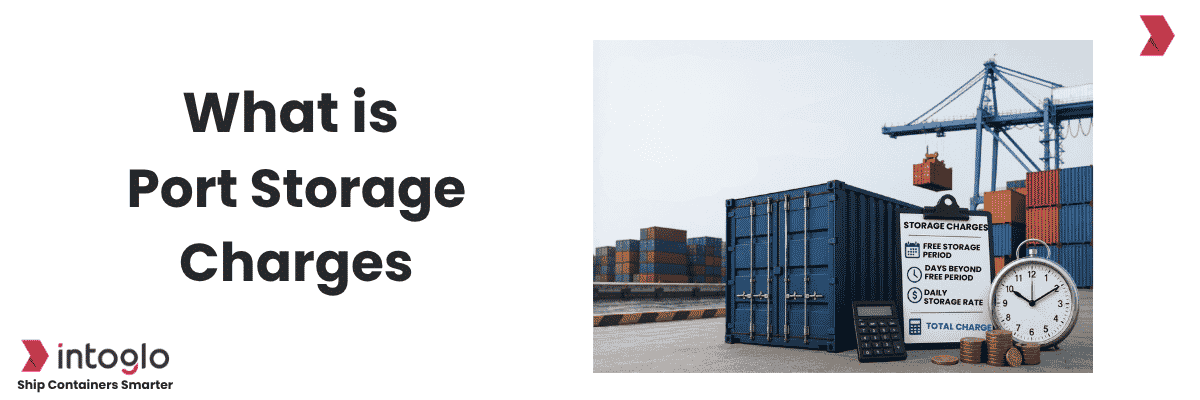
Port storage charges are fees incurred when cargo remains in the port beyond the allowed free storage time. These charges apply when containers or cargo are not cleared, collected, or moved out of the port within the permitted storage period.
These pointers explain how port storage charges work, who pays them, what causes them, and how exporters can reduce these costs:
- Storage charges are billed by the port authority or terminal operator and paid by the shipper or consignee based on the shipment terms.
- Triggered by delays such as customs holds, documentation issues, port congestion, or late pickups.
- They are calculated per day after free time, usually per container or per tonne.
- They can be avoided by early paperwork, planned transport, and timely tracking.
If you want to understand how demurrage and detention work and how to reduce these costs? Read our article on How Enterprise Shippers Reduce Demurrage & Detention Costs, to clearly understand these costs and how they differ from port storage charges.
What Are Port Storage Charges?
When a container or cargo arrives at a port, the port authority gives you a limited number of free days to move it out of their premises. Once those days expire, they start charging you for every additional day your goods occupy their space. These are storage charges.
Who Imposes Storage Charges?
Storage charges are levied by the port authority or terminal operator, not the shipping line. This is the key distinction from demurrage. Since they come from different parties, they are billed separately.
Who Is Responsible for Paying?
Storage charges are paid by the shipper or consignee based on the shipment terms. For India–USA exports, destination port storage charges are usually paid by the importer, while storage charges at the origin port in India before loading are generally the exporter’s responsibility.
When Do Storage Charges Apply?

Storage charges are triggered when cargo stays in the port or terminal beyond the free storage period.
- Customs clearance delays: Goods held for inspection or due to incomplete paperwork.
- Transport not arranged: Cargo cleared, but no truck booked to move it out.
- Port congestion: Operational delays at the terminal affect cargo movement.
- Documentation issues: Missing Bill of Lading, incorrect HS codes, or unpaid duties can freeze cargo release.
- Scheduling conflicts: The importer or consignee is unable to receive goods on time.
How Are Storage Charges Calculated?
The formula follows the same logic as other port charges:
Storage Charge = (Days beyond free period) × Daily Storage Rate
Example:
- Free storage period: 5 days
- Cargo stays for 8 days
- Daily rate: $30 per container
Total charge = 3 × $30 = $90
Rates are based on container size, cargo type, and the specific port. Some ports charge per tonne for bulk cargo; others charge per TEU (Twenty-foot Equivalent Unit).
Do Rates Change Over Time?
Yes, many ports use a slab-based structure: lower daily rates for the first few days after free time ends, then higher rates as the cargo stays longer. The longer you delay, the more expensive it gets.
How Port Storage Differs from Terminal Storage
Both ports and terminals charge for storage, but they're not the same thing.
- Port storage: Covers the general container yard managed by the port authority. Applies to most standard cargo.
- Terminal storage: Specific to a terminal operator within the port (common in large ports like JNPT or Los Angeles). The terminal has its own fee structure, separate from the port authority's charges.
As an exporter, you may receive separate invoices from both. Always ask your freight forwarder to clarify which facility your cargo is in.
How to Avoid Storage Charges
The easiest way to avoid storage charges is to plan clearance and pickup before your free days run out.
1. Submit all shipping documents at least 3-4 days before vessel arrival. This gives customs enough time to clear your cargo within the free period.
2. Confirm transport arrangements before the ship docks. Have a truck scheduled and ready.
3. Know the free storage days for the specific port. Ask your freight forwarder upfront.
4. Track your cargo in real time. Know when it arrives and when the clock starts.
5. Work with a freight forwarder who manages customs on your behalf and flags deadlines before they pass.
At Intoglo, we handle India–USA FCL shipments by coordinating directly with shipping lines, customs brokers, and truckers. We manage customs documentation and clearance across India and the USA time zones to help reduce delays that can lead to port storage charges. Trusted by 200+ businesses, we offer instant freight quotes, real-time shipment visibility, and updated sailing schedules to help exporters plan shipments more efficiently.
Need help with your shipment? Reach out to Intoglo:
📩 contact@intoglo.com | 📞 +91 84697 08714
Conclusion
Storage charges are a cost of delay. They're charged by the port, and they start accumulating the moment your free days expire. The best way to avoid them is to have your documentation ready, your transport arranged, and a freight partner who tracks the clock for you. A few hours of preparation can save you hundreds of dollars per shipment.
If you want to understand how demurrage, detention, and port storage charges differ from each other, read our article on How Demurrage, Detention & Storage Charges Differ in Shipping?
FAQs
Are storage charges the same as demurrage?
No, demurrage is charged by the shipping line, while storage charges are imposed by the port or terminal operator. Both are separate fees.
Who pays port storage charges on India-to-USA shipments?
For imports into the USA, the consignee (your importer) is generally responsible. For cargo sitting at Indian ports before departure, the exporter pays. Always clarify liability in your trade contract.
What happens if I don't collect my goods, and storage charges keep accumulating?
The port can eventually declare the cargo as abandoned. They may auction or destroy the goods to free up space. The costs are high - always act before the situation escalates.
Can I get storage charges waived?
Yes, sometimes. Ports may waive charges for delays caused by congestion, system failures, or natural disasters.