
Quick Overview
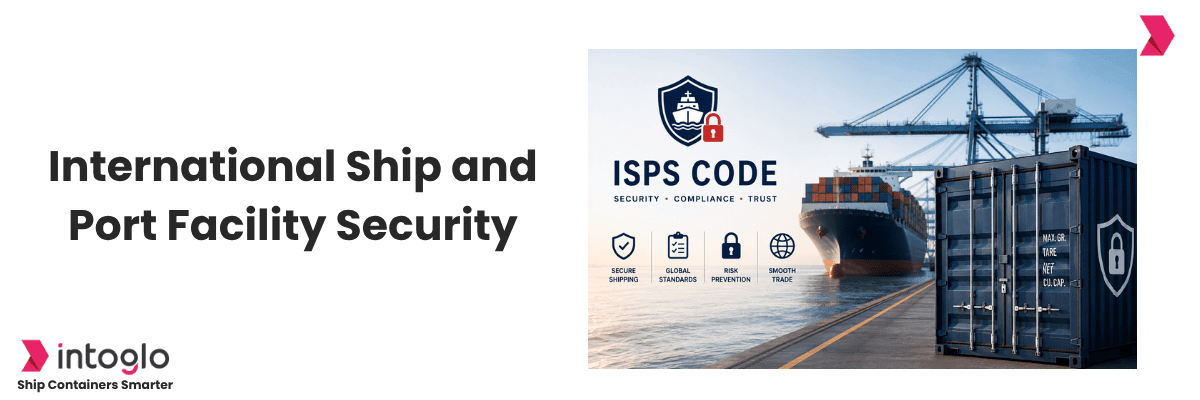
The International Ship and Port Facility Security Code (ISPS Code) is a mandatory global security framework established under Chapter XI-2 of the SOLAS Convention by the International Maritime Organization. It establishes standardized security protocols for cargo vessels and port facilities to prevent security threats, unauthorized access, and cargo tampering during ocean transit. For Indian exporters shipping Full Container Loads (FCL) to the USA, complying with ISPS requirements ensures smooth port clearance and avoids costly vessel delays.
Key facts about the ISPS Code in shipping at a glance:
- Enacted by the International Maritime Organization (IMO) under SOLAS Chapter XI-2, entering into force in July 2004.
- Mandatory for all passenger vessels and cargo ships of 500 gross tonnage (GT) and above on international voyages.
- Operates across 3 Maritime Security (MARSEC) levels: Level 1 (Normal), Level 2 (Heightened), and Level 3 (Exceptional).
- Carrier Security Fees (CSF) and Terminal Security Charges (TSC) typically range from $10 to $30 per container.
- Enforced across Indian major and non-major ports by the Directorate General of Shipping (DGS).
- Non-compliance can lead to vessel detention or port entry denial by the U.S. Coast Guard (USCG).
What Is the ISPS Code?
The ISPS Code establishes a comprehensive risk-management framework for international maritime trade. Developed following global security events, the code assigns specific responsibilities to government agencies, port authorities, and vessel operators. Because of this framework, ocean carriers and marine terminals must audit vulnerability points continuously.
| ISPS Framework Component | Primary Regulatory Objective | Responsible Authority |
|---|---|---|
| Part A (Mandatory Rules) | Binding security requirements for ships & port facilities | Contracting Governments & IMO |
| Part B (Guidance Notes) | Recommended implementation guidelines and best practices | Flag State Administrations |
| International Ship Security Certificate | Verification of approved onboard security systems | Classification Societies / DGS |
Why the ISPS Code Is Important for International Shipping?
Maritime security directly impacts global trade continuity and supply chain integrity. Without standardized security measures, container ships face elevated risks of unauthorized boarding, cargo smuggling, and port sabotage. As a result, compliance protects both vessel crews and commercial cargo during transit.
In addition, compliance directly affects port operations and clearance speeds. For instance, vessels arriving from non-compliant ports undergo rigorous offshore inspections by U.S. Customs and Border Protection (CBP). These delays can increase container yard storage fees and disrupt delivery schedules.
| Operational Impact | Risk Without ISPS Compliance | Compliance Benefit |
|---|---|---|
| Port Access & Clearance | Vessel entry denial or offshore inspection holds | Rapid port gate-in and customs clearance |
| Cargo Integrity | Unauthorized container access or contraband smuggling | Verified seal integrity and secure handling |
| Financial Predictability | Emergency security surcharges & port detention fees | Standardized, transparent carrier security charges |

Key Requirements and Security Levels of the ISPS Code
The ISPS Code utilizes a graduated three-tier Maritime Security (MARSEC) system to address varying threat levels. Governments set the active security level based on threat intelligence, and ships must adjust their security posture accordingly.
| MARSEC Threat Level | Operating Condition | Required Security Response |
|---|---|---|
| MARSEC Level 1 (Normal) | Standard baseline operational threat | Routine access control, continuous watches, & seal checks |
| MARSEC Level 2 (Heightened) | Increased risk of security incident | Enhanced inspections, restricted access, & extra patrols |
| MARSEC Level 3 (Exceptional) | Imminent or specific threat identified | Suspension of cargo handling, restricted movement, & armed guard interface |
How ISPS Code Compliance Works for Exporters?
While vessel operators and port facilities manage physical security infrastructure, exporters play a vital role in cargo documentation and container sealing. Exporters must ensure high-security bolt seals meet ISO 17712 standards before dispatching containers. In addition, shippers must pay applicable security surcharges on ocean freight bills.
For example, when moving cargo through an inland container depot, proper sealing prevents security breaches during transit. Exporters should also understand how terminal intake protocols operate by reviewing container yard guidelines. In addition, checking security fee structures helps clarify overall ocean freight surcharges before booking.
| Exporter Compliance Step | Key Requirement | Impact on Shipping Process |
|---|---|---|
| Container Seal Verification | Apply ISO 17712 high-security bolt seals | Prevents tampering and customs inspection holds |
| Accurate Shipping Documentation | Declare cargo contents and weight accurately | Facilitates smooth ISPS security screening |
| Surcharge Payment | Settle Carrier Security Fees ($10-$30/container) | Ensures timely Bill of Lading release |
Challenges and Solutions
| Export Operational Challenge | Strategic Logistics Solution |
|---|---|
| Unexpected security fees added to freight invoices | Verify Carrier Security Fees (CSF) in initial freight quotes. |
| Container clearance delays from damaged or mismatched seals | Maintain strict seal logs and audit container bolt seals prior to gate-in. |
| Heightened MARSEC level delays during regional trade tensions | Partner with digital forwarders offering real-time container tracking. |
How Intoglo Helps
Intoglo handles end-to-end FCL freight forwarding from India to the USA — container transportation, customs coordination, documentation, and final delivery, all through one platform with transparent pricing and real-time tracking.
Stay informed about carrier announcements, freight rates, and trade regulations by joining our free 30-minute monthly India-USA Trade Pulse webinar.
Planning your next shipment to the USA? Get a quote from Intoglo.
📩 contact@intoglo.com 📞 +91 84697 08714
Conclusion
Understanding the ISPS Code in shipping helps exporters navigate global security rules and avoid unexpected port delays across India-USA trade lanes. While vessel operators and port facilities maintain physical security infrastructure, exporters ensure compliance by applying ISO 17712 bolt seals and budgeting for $10 to $30 container security surcharges. By following standard terminal protocols and verifying documentation early, Indian exporters protect cargo integrity and maintain reliable delivery schedules throughout 2026.
FAQs
What does ISPS Code stand for in shipping?
ISPS stands for the International Ship and Port Facility Security Code. It is a mandatory international security framework developed by the International Maritime Organization (IMO) under the SOLAS Convention.
Who pays ISPS security charges in ocean freight?
The party responsible for paying the ocean freight (typically the shipper or consignee depending on Incoterms) pays the ISPS fee, which appears on ocean carrier invoices as a Carrier Security Fee (CSF) or Terminal Security Charge (TSC).
How much do ISPS charges usually cost per container?
ISPS security fees generally range from $10 to $30 per container, depending on the ocean carrier, marine terminal, and trade lane.
What are the three MARSEC levels under the ISPS Code?
The three levels are MARSEC Level 1 (Normal baseline security), MARSEC Level 2 (Heightened security due to increased risk), and MARSEC Level 3 (Exceptional security for imminent threats).
Do exporters need an ISPS certificate to ship cargo?
No. Exporters do not hold individual ISPS certificates. Instead, the ocean carrier vessel and the marine port facility hold the required ISPS compliance certifications. Exporters simply need to comply with container sealing and documentation rules.