
Quick Overview
As sustainability becomes a bigger part of global trade, many overseas buyers now ask suppliers to report the carbon footprint of every shipment. Calculating carbon emissions for India-USA ocean freight is relatively straightforward when you know the shipment weight, transport distance, and the appropriate emission factor of the vessel. Using internationally recognized methodologies also helps exporters meet customer requirements and improve ESG reporting.
Key facts about carbon emissions at a glance:
- Ocean freight produces lower CO₂ emissions than air freight.
- Carbon emissions are calculated using Weight × Distance × Emission Factor.
- Emission factors vary by vessel type, fuel, and reporting methodology.
- Many international buyers now request shipment-level emissions data.
- The GLEC Framework and ISO 14083 are widely used reporting standards.
Why Are Exporters Being Asked to Report Carbon Emissions?
Sustainability reporting has become an important part of international trade. Large retailers, manufacturers, and importers increasingly track emissions across their supply chains to meet ESG goals and regulatory requirements.
Providing shipment-level carbon data helps exporters:
- Meet customer sustainability requirements.
- Support ESG and Scope 3 emissions reporting.
- Respond to supplier qualification questionnaires.
- Compare different shipping options.
- Identify opportunities to reduce logistics emissions.
Businesses that can provide reliable emissions data often strengthen their relationships with global buyers.
Carbon Emissions at a Glance
| Metric | Typical Value |
| Typical Route | Nhava Sheva to New York |
| Shipping Distance | Approximately 14,500 to 15,500 km |
| Reporting Unit | kg CO₂e |
| Common Mode | Ocean Freight (FCL/LCL) |
| Reporting Standards | GLEC Framework, ISO 14083 |
How Are Ocean Freight Carbon Emissions Calculated?
The standard calculation uses three simple inputs.
Formula
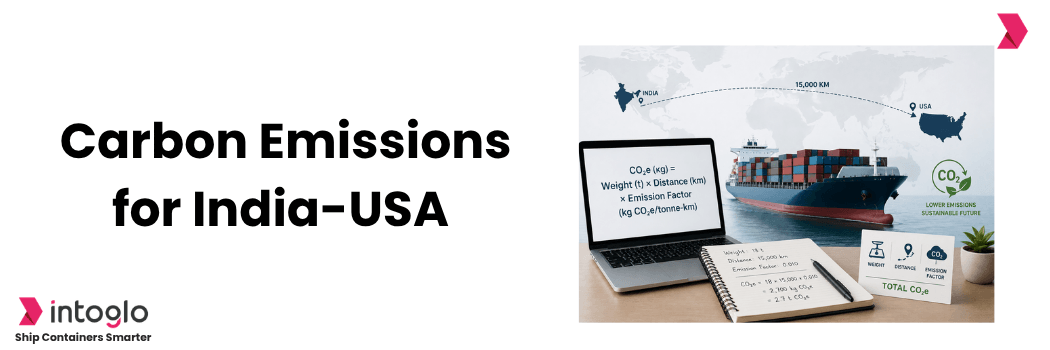
CO₂e (kg) = Cargo Weight × Distance × Emission Factor, using a recognized freight emissions methodology to estimate the shipment footprint.
Where:
- Cargo Weight is the shipment weight in tonnes.
- Distance is the transport distance in kilometers.
- Emission Factor represents the average emissions per tonne-kilometer for the transport leg, vessel class, and reporting methodology used.
This method is widely used by logistics providers and sustainability reporting platforms.
Example Calculation
Suppose you are shipping an 18-tonne container from Nhava Sheva to New York.
Emission Factor represents the average emissions per tonne-kilometer for the transport leg, vessel class, and reporting methodology used.
| Parameter | Value |
| Cargo Weight | 18 tonnes |
| Distance | 15,000 km |
| Emission Factor* | 0.010 kg CO₂e/tonne-km |
Calculation
18 × 15,000 × 0.010 = 2,700 kg CO₂e
That means the ocean freight leg of the shipment generates approximately 2.7 tonnes of CO₂e.
Illustrative value only. Businesses should use the latest GLEC Framework, ISO 14083, or carrier-provided emission factors whenever available.

What Affects Carbon Emissions?
Several operational factors influence the total emissions generated during ocean transportation.
| Factor | Impact |
| Cargo Weight | Heavier shipments generate higher emissions. |
| Shipping Distance | Longer routes increase total CO₂e. |
| Vessel Type | Modern vessels are generally more fuel efficient. |
| Fuel Type | Cleaner fuels can reduce emissions. |
| Container Utilization | Better utilization lowers emissions per unit of cargo. |
| Route Selection | Additional port calls or transshipment may increase emissions. |
Understanding these factors helps exporters estimate carbon emissions for India-USA more accurately.
Why Do Emission Factors Change?
There is no single emission factor that applies to every shipment.
Emission factors vary because they depend on:
- Vessel efficiency
- Fuel type
- Container utilization
- Shipping route
- Carrier operating data
- Reporting methodology
For consistent reporting, most companies follow the GLEC Framework or ISO 14083. Some shipping lines also provide shipment-specific carbon emission reports based on actual voyage data.
How Can Exporters Reduce Carbon Emissions?
Reducing emissions often starts with improving shipping efficiency rather than changing transport modes.
Some practical ways include:
- Consolidate shipments whenever possible.
- Maximize container utilization.
- Reduce unnecessary transshipment.
- Plan shipments early to avoid air freight.
- Choose carriers investing in lower-emission vessels.
- Measure emissions consistently to identify improvement opportunities.
Even small operational improvements can lower both transportation costs and carbon emissions over time.
Carbon reporting is becoming just as important as understanding tariffs and import duties. Learn how the latest US Section 301 tariffs on India could affect your shipments and landed costs.
Reporting Best Practices
Businesses that regularly export to the USA should develop a consistent approach to emissions reporting.
| Recommendation | Why It Matters |
| Use GLEC Framework or ISO 14083 | Ensures globally accepted reporting. |
| Collect carrier emissions data | Provides more accurate shipment estimates. |
| Track emissions shipment-wise | Improves customer reporting and ESG compliance. |
| Maintain historical records | Helps measure long-term sustainability performance. |
Using a consistent reporting method makes it easier to compare emissions across different shipments and customers.
How Intoglo Helps?
As more buyers request shipment-level sustainability data, exporters need better visibility across their logistics operations.
Intoglo provides end-to-end digital FCL freight forwarding from India to the USA with real-time shipment tracking and transparent logistics management.
Stay informed about carrier announcements, freight rates, and trade regulations by joining our free 30-minute monthly India-USA Trade Pulse webinar.
Planning your next shipment to the USA? Get a customized freight quote from Intoglo.
📩 Contact Intoglo 📞 +91 84697 08714
Conclusion
Calculating carbon emissions for India-USA ocean freight is becoming an essential part of international trade. By using shipment weight, transport distance, and recognized emission factors, exporters can provide accurate emissions data to customers and support their sustainability goals. Following accepted reporting standards such as the GLEC Framework and ISO 14083 also improves consistency, strengthens ESG reporting, and prepares businesses for evolving global compliance requirements.
FAQs
How do you calculate carbon emissions for ocean freight?
Multiply the cargo weight, transport distance, and the applicable emission factor.
What unit is used to report freight emissions?
Most businesses report freight emissions in kilograms of carbon dioxide equivalent (kg CO₂e).
Why do emission factors differ?
They vary based on vessel efficiency, fuel type, route, load factor, and the reporting methodology used.
Which reporting standard should exporters use?
The GLEC Framework and ISO 14083 are among the most widely accepted standards for freight emissions reporting.
Can two shipments on the same route have different emissions?
Yes. Differences in cargo weight, vessel type, routing, and container utilization can result in different carbon emission values.