Quick Overview
Exporters often choose between CFS, ICD, and dry ports without fully understanding how each facility differs. This article explains what CFSs, ICDs, and dry ports are and when exporters should use each one. It also highlights key differences, common use cases, and decision factors to help exporters select the right facility.
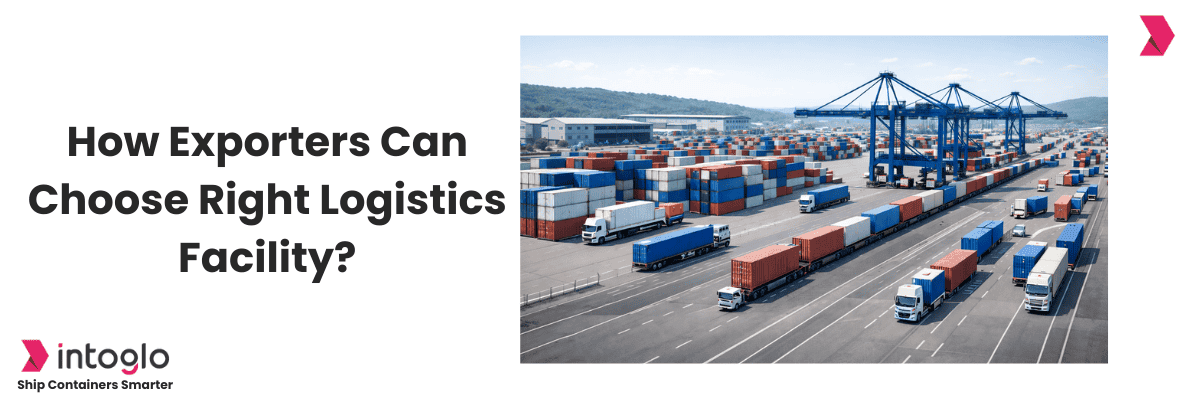
Exporters often come across multiple inland logistics facilities Container Freight Stations (CFS), Inland Container Depots (ICDs), and dry ports while planning shipments.
While these terms are frequently used interchangeably, each serves a distinct purpose in the export–import process. Choosing the wrong facility can lead to higher costs, delays, or operational inefficiencies.
Why Exporters Get Confused
ICDs, CFSs, and dry ports are often mistaken for one another because they handle similar activities such as container storage, cargo movement, customs clearance processes and are often connected to the same seaports.
However, their location, authority, scope of operations, and ideal use cases vary significantly.
Container Freight Station (CFS)
A Container Freight Station is a logistics facility located at or near a seaport.
Key Characteristics
CFSs support port-based operations by handling consolidation, deconsolidation, and short-term storage, acting as a link between the port and exporters or importers.
When Exporters Use a CFS
CFSs are ideal for LCL shipments, exporters located close to seaports, smaller consignments, and cargo that requires temporary storage or processing before vessel loading.
Inland Container Depot (ICD)
An Inland Container Depot is a customs-notified facility located away from seaports, functioning as an inland extension of the port.
Key Characteristics
An Inland Container Depot (ICD) offers full customs clearance, handles FCL and LCL cargo, connects to ports by rail and road, and provides warehousing, stuffing, de-stuffing, and documentation services.
When Exporters Use an ICD
Exporters use an ICD when factories are inland, to avoid port congestion, for cost-efficient rail transport, and for end-to-end export processing at inland locations.
Dry Port
A dry port is a large inland logistics hub that performs many of the same functions as a seaport but without direct sea access.
Key Characteristics
A dry port has strong rail connectivity with one or more seaports and offers full customs clearance facilities. It is designed to handle high container volumes and supports multimodal transport through rail and road. Dry ports help reduce congestion at seaports by shifting cargo handling inland
When Exporters Use a Dry Port
Dry ports are ideal for exporters with large shipment volumes, rail-focused supply chains, and cargo moving from deep inland locations to seaports.
CFS, ICD, and Dry Port: Key Differences
These facilities play distinct roles in containerized trade, and understanding their differences helps exporters choose the most efficient option for their cargo.
| Feature | CFS (Container Freight Station) | ICD (Inland Container Depot) | Dry Port |
| Location | Near or adjacent to seaport | Inland, away from seaport | Inland, usually on major rail corridors |
| Customs Clearance | Limited, linked to port customs | Full customs clearance | Full customs clearance |
| Cargo Type | Mostly LCL | FCL and LCL | Mostly FCL, high-volume cargo |
| Rail Connectivity | Limited or none | Yes (rail and road) | Strong rail connectivity |
| Storage | Short-term | Short and long-term | Long-term, large-scale |
| Primary Role | Supports port operations | Inland extension of the port | Decentralizes port cargo inland |
| Ideal For | Port-based, LCL cargo | Inland exporters | High-volume trade corridors |
How to Choose the Right Facility
Choosing the right facility depends on your shipment type, location, volume, and customs needs:
- Shipment Type: Use CFS for LCL (small shipments) and ICD or Dry Port for FCL (full containers).
- Location: Use CFS if you are near a seaport; use ICD or Dry Port if you are inland.
- Customs Clearance: ICD and Dry Port provide full customs clearance; CFS mainly handles port-side cargo.
- Connectivity: ICD and Dry Port have good road and rail links; CFS mostly uses roads.
- Volume: CFS is best for small shipments, ICD for standard full containers, Dry Port for high-volume cargo.
- Port Congestion: ICD and Dry Port help avoid congestion; CFS operates near the port for quick handling.
Choosing between the right facilities can significantly impact your shipment costs and timelines. Working with an experienced logistics partner like Intoglo helps ensure the right facility is chosen for every export.
Intoglo provides a monthly India–USA sailing schedule with all vessels and ports at one place, updated every month. Never miss another vessel plan your shipments efficiently without chasing multiple liner sites or endless follow-ups
To explore how Intoglo can transform your India-US FCL shipping, connect with us :
📩 contact@intoglo.com | 📞 +91 84697 08714
Conclusion
Choosing the right facility CFS, ICD, or dry port depends on shipment size, location, and customs needs. Using the appropriate facility ensures smoother cargo movement, cost efficiency, and timely delivery. Partnering with a reliable freight forwarder can simplify the process and keep your supply chain running efficiently.
FAQs
Can an exporter use both CFS and ICD for the same shipment?
Yes, in some cases, LCL cargo may be consolidated at a CFS near the port and then moved inland to an ICD for customs clearance or storage. However, for FCL shipments, exporters usually choose one facility to streamline operations.
How do shipping costs compare between CFS, ICD, and dry ports?
CFS is typically cheaper for small, port-adjacent shipments but may incur higher storage fees if cargo waits at the port. ICDs and dry ports may reduce inland transport costs and port congestion fees, especially for full container shipments.
Are all ICDs and dry ports connected to rail networks?
Most ICDs and dry ports have rail connectivity to major seaports, which lowers transportation costs and improves reliability. Some smaller ICDs rely primarily on road transport.
Can customs clearance be done entirely at an ICD or dry port?
Yes, both ICDs and dry ports are customs-notified facilities. Exporters can complete full import/export documentation, inspections, and duty payments inland without needing to visit the seaport.
Do CFSs handle both imports and exports?
Yes, CFSs handle both imports and exports, but their customs processing is limited and usually depends on proximity to the port. They are most effective for smaller or consolidated shipments.
Can exporters avoid port congestion by using an ICD or dry port?
Yes, ICDs and dry ports shift cargo handling inland, which reduces wait times at congested seaports and allows smoother scheduling for vessels and inland transport.
Are ICDs and dry ports suitable for time-sensitive shipments?
Yes, they are ideal for shipments requiring reliable schedules, especially when rail transport is used. They help avoid delays due to port congestion and improve inland delivery predictability.
How does choosing the right facility impact supply chain efficiency?
Using the right facility ensures timely customs clearance, optimized inland transport, lower costs, and reduced risk of delays, improving overall export-import efficiency.