Quick Overview
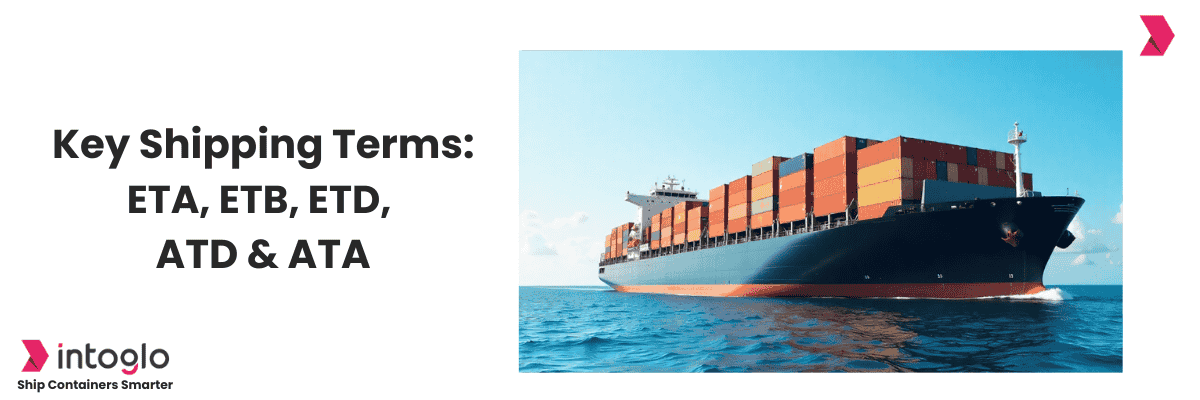
Shipping timelines are crucial for smooth logistics. This article explains the key terms ETA, ETB, ETD, ATD, and ATA, how they help exporters plan trucks, coordinate with customs and inland transport, optimize warehouse space, and ensure that India–USA FCL shipments move seamlessly from origin to destination.
Timing is everything in shipping. Knowing when a vessel will arrive, dock, or depart can save money, reduce delays, and keep customers happy. Terms like ETA, ETB, ETD, ATD, and ATA may sound tricky, but understanding them makes planning easier and ensures your shipments run smoothly.
Logistics Terms for Tracking Shipments
Understanding shipping timelines helps avoid delays, plan resources, and manage operations efficiently. These terms are essential for exporters and logistics teams to keep shipments on track.
1. Estimated Time of Arrival (ETA)
ETA is the expected time when a vessel reaches the port area. It helps coordinate customs, trucking, and warehouse operations.
Factors that affect ETA include vessel location, speed, weather, port congestion, and customs delays. For example, if a ship’s ETA at New York is January 25, exporters can schedule trucks and warehouse space accordingly.
2. Estimated Time of Berthing (ETB)
ETB is the expected time when a vessel docks and is ready for loading or unloading. Unlike ETA, which shows arrival at the port, ETB indicates actual docking.
ETB is important for planning labor, cranes, and cargo operations. Port congestion or delays from previous vessels can impact ETB.
3. Estimated Time of Departure (ETD)
ETD is the scheduled time when a vessel leaves the port. It helps exporters plan cargo dispatch, documentation, and inland transport.
ETD can be affected by port congestion, loading delays, weather conditions, or vessel readiness.
4. Actual Time of Departure (ATD)
ATD is the exact time a vessel actually departs. Unlike ETD, it shows the real departure time.
Knowing ATD helps track operational efficiency and identify delays, allowing logistics teams to update downstream schedules in real time.
5. Actual Time of Arrival (ATA)
ATA is the exact time a vessel reaches its destination. It differs from ETA, which is only an estimate.
ATA is important for performance tracking, informing customers, and planning cargo operations at the destination port.
How Exporters Can Use Shipping Timelines to Improve Operations
Accurate shipping timelines are essential for exporters to keep operations smooth and efficient. By understanding these shipping terms exporters can plan logistics more effectively, avoid delays, and ensure that cargo moves seamlessly from origin to destination.
- Understanding ETA, ETB, ETD, ATD, and ATA helps exporters plan truck arrivals and scheduling at both origin and destination ports.
- Enables better coordination with customs agents and inland transport partners, reducing potential delays.
- Clear time expectations allow logistics teams to optimize warehouse space and labor deployment.
- Tracking actual vs. estimated times helps identify bottlenecks and improve future shipment planning.
For exporters shipping full container loads (FCLs) from India to the USA, having clear visibility across pick-up, vessel movement, and delivery timelines is essential.
Intoglo provides a monthly India–USA sailing schedule with updated vessel ETDs in one place for all major shipping lines running from India to USA. You can download the schedule to plan sailings confidently every month without tracking multiple carrier websites or relying on follow-ups.
To explore how Intoglo can transform your India-US FCL shipping, connect with us :
📩 contact@intoglo.com | 📞 +91 84697 08714
Conclusion
Understanding ETA, ETB, ETD, ATD, and ATA helps exporters avoid delays, use resources wisely, and keep shipping operations running smoothly. Knowing the shipping schedule clearly makes planning easier and keeps shipments on time. Working with Intoglo ensures reliable India–USA FCL shipping and a smooth, end-to-end delivery process.
To improve India–USA FCL Shipping Efficiency read our next guide to optimize ETA and ETD tracking How Technology Improves ETA & ETD Accuracy in India-US Shipping.
FAQs
What is the difference between ETA and ATA for my shipment?
ETA (Estimated Time of Arrival) is when my vessel is expected to reach the port, while ATA (Actual Time of Arrival) is the exact time it arrives. Knowing ATA helps me track performance and plan the next steps for my cargo.
Why does my ETD often change?
My ETD (Estimated Time of Departure) can change because of loading delays, port congestion, vessel readiness, or bad weather. Monitoring updates helps me adjust my logistics plans in time.
What is the role of ATD for my shipment?
ATD (Actual Time of Departure) is the exact time my vessel leaves the port. Knowing ATD helps me compare planned schedules with reality and adjust trucking, warehouse, and delivery arrangements.
How can tracking ETA, ETB, ETD, ATD, and ATA reduce delays for my shipments?
By tracking both estimated and actual times, I can plan truck arrivals, customs clearance, and warehouse operations better. This minimizes idle time, avoids extra costs, and keeps my shipments on schedule.
Are ETA and ETD the same for every shipment I send?
No, ETA is when my vessel reaches the port, and ETD is when it leaves. Differences in ports, routes, or operations can cause ETA and ETD to vary for my shipments.
How does understanding these shipping terms help me with FCL shipments?
For my full container load (FCL) shipments, knowing ETA, ETB, ETD, ATD, and ATA helps me coordinate pick-up, vessel transit, and delivery efficiently, reducing delays and keeping my customers satisfied.