Quick Overview
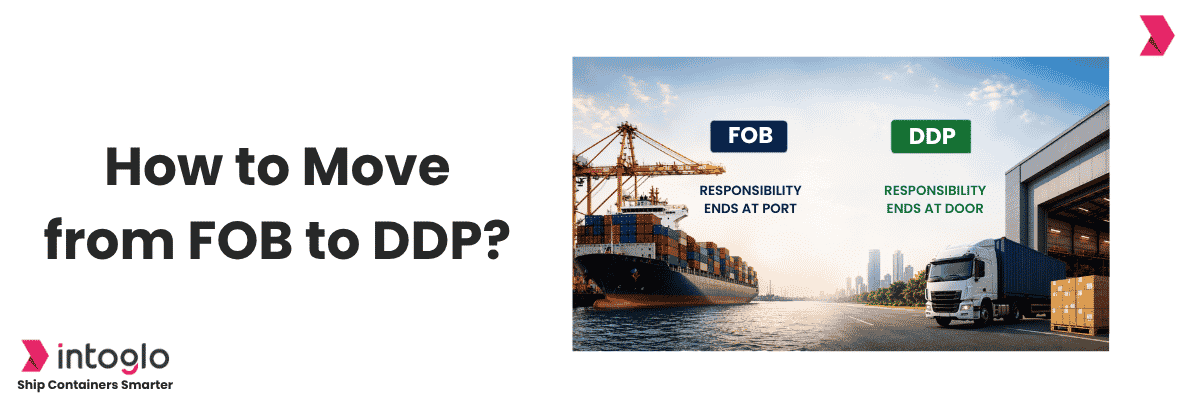
FOB to DDP is the process of moving from a shipping model in which the importer manages transportation and import costs to one in which the exporter assumes responsibility for transportation, customs clearance, duties, and final delivery to the importer's location.
Before transitioning from FOB to DDP, exporters should understand the key operational changes involved:
- FOB and DDP assign logistics responsibilities differently.
- DDP requires exporters to manage international freight and destination delivery.
- Import compliance, customs clearance, and duty payments become the exporter's responsibility.
- Accurate landed cost calculations are essential for profitable DDP pricing.
- Strong logistics and customs partners are critical for successful DDP operations.
- DDP can improve customer experience by offering a complete door-to-door service.
Understanding these requirements can help exporters build the processes, partnerships, and pricing models needed to manage DDP shipments successfully.
Understanding the Difference Between FOB & DDP
FOB and DDP are both widely used Incoterms, but they assign responsibility for transportation, customs clearance, duties, and delivery to different parties.
| Aspect | FOB (Free on Board) | DDP (Delivered Duty Paid) |
| Transportation Responsibility | The importer arranges international transportation. | The exporter arranges transportation from origin to destination. |
| Import Customs Clearance | The importer handles import clearance. | Exporter handles import clearance. |
| Duties & Taxes | The importer pays duties and taxes. | The exporter pays duties and taxes. |
| Final Delivery | Importer’s responsibility. | Exporter's responsibility. |
| Risk Transfer | When goods are loaded onto the vessel. | Upon delivery at the buyer's location. |
| Exporter's Scope | Ends at the port of shipment. | Covers the entire shipment journey. |
| Customer Experience | Buyer manages multiple logistics activities. | Buyer receives a door-to-door service. |
Moving from FOB to DDP means shifting from a port-to-port shipping model to a complete door-to-door logistics model.
FOB and DDP are just two of the 11 Incoterms used in international trade. To understand all Incoterms rules, responsibilities, and their impact on shipping costs and risk, read What are INCOTERMS? A Guide to Rules & Responsibilities.
Operational Shifts Needed to Move from FOB to DDP Shipments

Moving from FOB to DDP means taking responsibility for transportation, customs clearance, duties, and delivery to the buyer's location. To manage DDP shipments efficiently, exporters need to make the following operational changes.
1. Take Control of International Freight
Under FOB, freight decisions are handled by the buyer. Under DDP, exporters become responsible for moving cargo from India to the customer's location.
This requires:
- Selecting carriers and routes.
- Managing freight bookings.
- Monitoring transit performance.
- Controlling shipping costs.
- Tracking shipments throughout transit.
A reliable freight strategy is the foundation of successful DDP operations.
2. Build a US Import Compliance Process
DDP shipments make the exporter responsible for ensuring goods can be imported into the United States without compliance issues.
Key areas include:
- Correct HS code classification.
- Accurate commercial documentation.
- Country-of-origin declarations.
- Product-specific regulatory requirements.
- Customs entry preparation.
Errors in classification or documentation can result in shipment delays, additional inspections, or unexpected costs.
3. Calculate Landed Cost Accurately
One of the biggest challenges when moving to DDP is pricing. Unlike FOB shipments, exporters must account for all destination costs before providing a quote.
These costs typically include:
- Ocean or air freight.
- Customs duties.
- Import taxes.
- Customs brokerage fees.
- Port and terminal charges.
- Inland transportation costs.
A detailed landed cost model helps exporters maintain margins while offering competitive DDP pricing.
4. Establish Customs Clearance Support in the USA
Successful DDP shipments require strong destination support.
Most exporters work with:
- Licensed customs brokers.
- Freight forwarders with US operations.
- Compliance specialists.
- Domestic transportation providers.
These partners help ensure cargo clears customs efficiently and reaches the buyer without delays.
5. Develop a Last-Mile Delivery Network
DDP responsibility does not end at customs clearance. The shipment must still be delivered to the customer's warehouse, store, distribution center, or project site.
Exporters need systems for:
- Domestic trucking.
- Delivery scheduling.
- Warehouse coordination.
- Proof of delivery.
- Shipment visibility.
Reliable last-mile delivery is essential for maintaining customer satisfaction and meeting delivery commitments.
How Intoglo Helps Exporters Transition from FOB to DDP
Transitioning from FOB to DDP requires exporters to manage freight, customs clearance, duties, and destination delivery.
Intoglo provides end-to-end digital FCL forwarding for shipments from India to the USA. By working directly with shipping lines, customs brokers, and trucking partners in the USA, Intoglo helps exporters manage transportation, customs clearance, shipment tracking, and door-to-door delivery through a single platform.
Trusted by 200+ businesses, Intoglo offers instant freight quotes, real-time shipment visibility, and delivery coverage across 41,000+ USA ZIP codes. The company supports a wide range of export categories, including auto parts, chemicals, paper and packaging products, pharmaceuticals, and other high-volume shipments.
By combining freight, customs clearance, and destination delivery services, Intoglo helps exporters streamline DDP operations.
Need help with smooth India-USA shipping? Contact Intoglo:
📩 contact@intoglo.com | 📞 +91 84697 08714
Conclusion
Moving from FOB to DDP shipments requires more than changing Incoterms. Exporters must take ownership of freight management, import compliance, duty calculations, customs clearance, and final delivery. With the right logistics partners, compliance processes, and landed cost planning, Indian exporters can successfully offer door-to-door delivery and meet the growing demand for DDP shipments in the US market.
FAQs
Why are buyers increasingly requesting DDP shipments?
DDP simplifies the buying process because the seller manages transportation, customs clearance, duties, and delivery, providing predictable landed costs for the buyer.
What is the biggest challenge when moving from FOB to DDP?
Accurately calculating landed costs and managing import compliance are typically the most challenging aspects of DDP shipments.
Do exporters need a customs broker for DDP shipments?
In most cases, exporters work with licensed customs brokers to facilitate import clearance and ensure regulatory compliance.
Can small exporters offer DDP shipments?
Yes. Many small and medium-sized exporters offer DDP by partnering with logistics providers that handle freight, customs clearance, and last-mile delivery.
Is DDP more profitable than FOB?
DDP can increase competitiveness and create additional revenue opportunities, but profitability depends on accurate cost calculations and efficient logistics management.