Quick Overview
Middle East tensions are disrupting shipping and raising costs for India–USA trade. This article explains how carriers are rerouting ships, transit times are increasing, and freight rates are rising. It also highlights the challenges exporters face and offers tips to plan shipments and manage risks effectively.
Rising tensions between the US, Israel, and Iran are creating uncertainty for global shipping routes. Security risks are increasing around key maritime corridors such as the Strait of Hormuz and the Bab el-Mandeb Strait, which are important gateways for global trade.
The Bab el-Mandeb Strait connects the Red Sea to global trade routes that lead to the Suez Canal, one of the most important shipping passages linking Asia and Europe. As a result, the India-USA shipping corridor, which relies on the Suez route, is also experiencing operational and cost pressures.
Shipping Routes to the US East Coast Changing

Shipping routes from India to the US East Coast are changing as carriers avoid risk-prone areas in the Middle East. To maintain safety and keep services running, several shipping lines have adjusted their routes and schedules.
- Many services are now rerouting around the Cape of Good Hope rather than passing through the Red Sea.
- This route helps vessels avoid sensitive maritime chokepoints in the Middle East.
- Major carriers affected include Maersk, CMA CGM, OOCL, and COSCO.
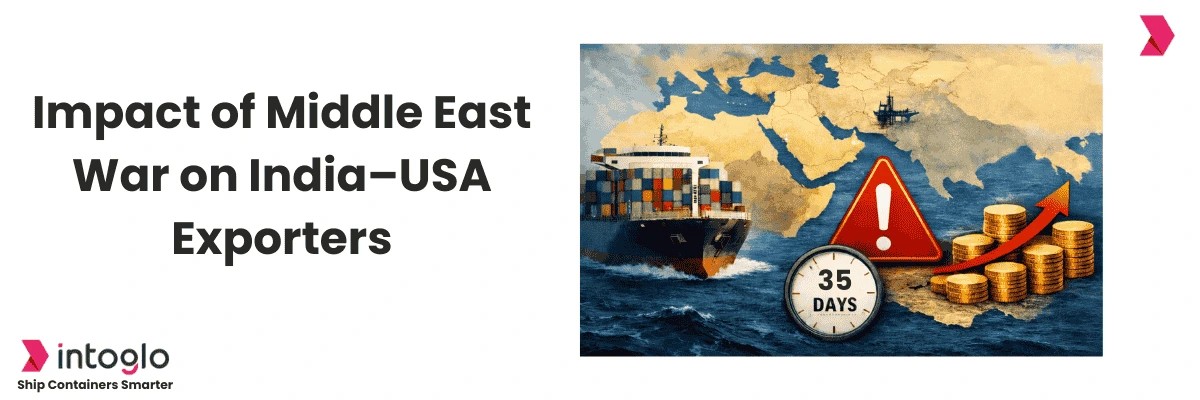
- Transit times have increased from 25 days to 35 days.
- Maersk and CMA CGM have announced back-to-back blank sailings, with no vessels operating after 15th March until the end of the month.
- Hapag-Lloyd, Ocean Network Express, and MSC were already using the Cape of Good Hope route, so their schedules have not changed much. However, freight rates are increasing due to Peak Season Surcharges (PSS).
Why Are Freight Costs Increasing?
Shipping costs are rising as carriers adjust to longer routes and operational disruptions. Many shipping lines have introduced Peak Season Surcharges (PSS) in March to manage higher operating costs.
| Shipping Line | PSS Update |
| Hapag-Lloyd | USD 1,000 per container after 14th March; expected to increase USD 2,000 after 31st March. |
| Maersk | USD 3,000 per container applied from 19th March; No vessels till the end of the month. |
| CMA CGM | USD 2,000 per container applied after 14th March. |
| OOCL & COSCO | PSS is expected but not announced yet. |
The West Coast trade lane remains unaffected by the current war, with sufficient vessel availability. Freight rates are also similar to last month for now.
How Port Disruptions Are Affecting Cargo Movement?
Port operations across parts of the Middle East are facing disruptions, which are affecting cargo movement and transshipment activities.
- Several Middle East ports are closed or only partially operational due to the ongoing situation.
- Many shipping lines are not accepting bookings to these ports, which is limiting cargo movement in the region.
- Cargo that usually moves through a transshipment hub like Jebel Ali Port is being affected, creating delays in shipments.
- However, Port of Salalah (the main port for Maersk in Oman) remains operational and continues to handle some cargo.
Impact on Shipping Operations
The ongoing disruptions are creating several operational challenges for exporters and logistics providers.
- Container shortages are increasing because containers are spending more time at sea due to longer shipping routes.
- Blank sailings announced by some carriers are reducing vessel availability, making it harder to secure bookings.
- Port congestion may increase at major Indian ports such as Jawaharlal Nehru Port (Nhava Sheva) and Mundra Port, as shipments face delays and schedule changes.
- In some regions, Dangerous Goods (DG) and refrigerated cargo (reefer) bookings are also facing restrictions or delays.
What Should Indian Exporters Do?
Exporters should stay prepared and reduce risk by following some practical shipment planning steps in the current shipping environment.
- Plan shipments 2–3 weeks earlier than usual to manage longer transit times.
- Check freight rates before booking cargo to avoid sudden cost changes.
- Review contract terms to understand who will pay surcharge costs.
- Add a 15–20 day safety margin in delivery schedules.
- For shipments bound for the U.S. East Coast, plan in advance and keep buffers to manage the volatile situation, potential rollovers, and cost fluctuations.
Working with reliable freight forwarders can help manage shipping uncertainty. Intoglo is working with all major carriers to help you stay updated on the latest route changes and surcharges on the India–USA lane. The India–USA sailing schedule is also being updated. You can download it here to plan shipments easily without checking multiple carrier websites.
To learn how Intoglo can help with your India–USA FCL shipping, connect with us:
📩 contact@intoglo.com | 📞 +91 84697 08714
Conclusion
Rising tensions in the Middle East are leading to route changes, higher freight costs, and longer transit times for global shipping. While India–USA trade continues, logistics planning has become more complex due to schedule changes and capacity constraints. Exporters should plan shipments early and work closely with experienced freight forwarders like Intoglo to manage route changes, rate fluctuations, and possible delays more effectively.
FAQs
Are there alternative routes besides the Cape of Good Hope?
Currently, the Cape of Good Hope route is the safest alternative for avoiding Middle East chokepoints. Some carriers may also explore partial transshipment through ports like Salalah (Oman) or Indian transshipment hubs, but options remain limited.
Which carriers are most affected by Middle East tensions?
Major carriers like Maersk, CMA CGM, OOCL, and COSCO have rerouted vessels and announced blank sailings. Carriers such as Hapag-Lloyd, Ocean Network Express (ONE), and MSC were already using the Cape of Good Hope route, so their schedules remain mostly unchanged.
What types of cargo are most affected by delays?
Dangerous Goods (DG), refrigerated cargo (reefer), and time-sensitive shipments face the most restrictions due to safety regulations, port congestion, and rerouted vessels.
Will freight rates continue to increase in the coming months?
Freight rates may continue to rise if tensions persist, capacity remains constrained, or if carriers extend Peak Season Surcharges. Exporters should monitor market trends and plan bookings in advance.
Are freight rates rising on the India–USA trade lane?
Yes, longer routes, reduced vessel availability, and additional operational costs are pushing freight rates higher for India–USA shipments.
What is the Bab el-Mandeb Strait, and why is it strategically important?
The Bab el‑Mandeb Strait is a narrow waterway connecting the Red Sea to the Gulf of Aden. A large portion of global container traffic and oil shipments passes through this corridor, making it a critical point for international shipping.
Why do longer shipping routes increase freight rates?
Longer routes mean ships spend more time at sea, consume more fuel, and complete fewer trips each year. This reduces the overall availability of vessels, which tightens shipping capacity and pushes freight rates higher.