
Quick Overview
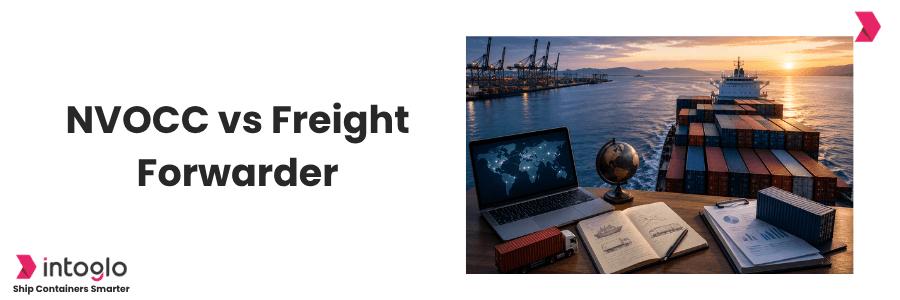
Understanding the distinction between an NVOCC vs freight forwarder helps optimize ocean freight operations across India-USA trade corridors. A Non-Vessel Operating Common Carrier (NVOCC) functions legally as an ocean carrier, issuing its own House Bill of Lading and assuming direct cargo liability. On the other hand, a traditional freight forwarder acts as an intermediary agent, coordinating multimodal transportation, customs clearance, and end-to-end supply chain logistics.
Key facts about NVOCC vs freight forwarder services at a glance:
- NVOCCs must hold a valid registration with India's Directorate General of Shipping (DGS) as a Multimodal Transport Operator.
- For US-bound cargo, NVOCCs must maintain an active license and a $150,000 financial bond with the Federal Maritime Commission (FMC).
- Freight forwarders organize door-to-door logistics using third-party carrier networks under FIATA operational standards.
- NVOCCs buy bulk container slots directly from vessel operators, often offering predictable rates for high-volume FCL shipments.
- Freight forwarders handle complex customs broker coordination, inland drayage, and warehousing documentation.
- Many modern logistics providers hold dual licensing, acting as both forwarders and NVOCCs depending on cargo needs.
Core Operational Differences
Evaluating an NVOCC vs freight forwarder requires looking at legal status, documentation, and liability structures. Because the legal relationship changes between these service models, Indian exporters face different operational responsibilities. NVOCCs act as contractual carriers toward shippers, while forwarders usually act as booking agents.
| Feature Parameter | NVOCC (Non-Vessel Operating Common Carrier) | Ocean Freight Forwarder |
|---|---|---|
| Legal Role | Contractual Common Carrier | Intermediary Agent / Coordinator |
| Bill of Lading Issued | Issues own House Bill of Lading (HBL) | Uses Carrier Master BL or Forwarder BL |
| US Regulatory Oversight | Licensed and bonded by US FMC | Regulated as Ocean Transportation Intermediary |
| Container Slot Sourcing | Leases or purchases direct carrier block space | Books space per shipment via ocean lines |
| Primary Service Focus | Ocean container movement & slot pricing | End-to-end multimodal logistics & customs |

Carrier Liability and Regulatory Compliance
Exporters shipping goods from Indian ports to US destinations must manage strict maritime compliance. Under the India Multimodal Transportation of Goods Act, companies issuing transport documents must possess MTO registration. As a result, an NVOCC assumes primary carrier liability for lost or damaged cargo during ocean transit.
In addition, US trade regulations enforced by the Federal Maritime Commission (FMC) require NVOCCs to publish tariff rates and maintain financial security bonds. Choosing an FMC-compliant partner protects exporters against unexpected charges or carrier default.
| Compliance Metric | India DGS Requirement | US FMC Requirement | Primary Benefit to Exporter |
|---|---|---|---|
| NVOCC Standard | Valid MTO License & Financial Proof | $150,000 Foreign NVOCC Bond | Direct carrier liability recourse |
| Forwarder Standard | Form 13 / Customs Broker License | OTI Registration / Tariff Compliance | Smoother customs clearance |
Choosing the Right Partner for Your Cargo
Selecting between these providers depends on shipment size, routing flexibility, and documentation capacity. For example, high-volume exporters moving regular FCL containers often secure better port-to-port pricing through NVOCC slot allocations. However, businesses requiring factory pick-ups, complex documentation, and destination warehousing usually benefit from freight forwarder coordination.
| Exporter Operational Need | Recommended Service Partner | Operational Reason |
|---|---|---|
| Large-Volume FCL Ocean Shipping | NVOCC | Access to bulk slot pricing & stable rates |
| Complex Door-to-Door Logistics | Ocean Freight Forwarder | Full coordination of inland transport & customs |
| LCL Cargo Consolidation | NVOCC or Dual-Licensed Partner | Direct container packing & lower handling fees |
Challenges and Solutions
| Export Operational Challenge | Strategic Logistics Solution |
|---|---|
| Rate volatility during peak ocean shipping seasons | Partner with NVOCCs utilizing long-term volume slot contracts. |
| Unexpected port storage and delay charges | Review demurrage vs detention charges to prevent port delays. |
| Customs clearance delays at US arrival ports | Follow official US customs requirements and work with integrated brokers. |
| Hidden port and shipping costs | Read our breakdown on ocean freight bills to audit carrier charges. |
How Intoglo Helps
Intoglo handles end-to-end FCL freight forwarding from India to the USA - container transportation, customs coordination, documentation, and final delivery, all through one platform with transparent pricing and real-time tracking.
Need help with your India–USA shipments? Get a quote from Intoglo.
Stay informed about freight rates, carrier updates, and trade regulations by joining our free 30-minute monthly India-USA Trade Pulse webinar.
📩 contact@intoglo.com 📞+91 84697 08714
Conclusion
Choosing between an NVOCC vs freight forwarder depends on whether an exporter prioritizes direct carrier slot pricing or complete door-to-door management. Because NVOCCs provide carrier-level House Bills of Lading under FMC $150,000 bonding rules, they offer strong direct liability coverage for ocean legs. Evaluating container volumes and destination compliance needs helps Indian exporters select the right partner to protect margins and keep shipments moving smoothly.
FAQs
Can a single company operate as both an NVOCC and a freight forwarder?
Yes. Many global logistics organizations maintain dual licensing. This setup lets them issue House Bills of Lading as an NVOCC for ocean transit while offering end-to-end forwarding, customs brokerage, and inland drayage.
What is the main difference in Bill of Lading issuance?
An NVOCC issues its own legal House Bill of Lading (HBL) and acts as the carrier towards the exporter. A traditional freight forwarder acts as an agent, booking space under the ocean shipping line’s Master Bill of Lading (MBL) or forwarding documents.
Do NVOCCs own their own cargo ships?
No. NVOCC stands for Non-Vessel Operating Common Carrier. They do not own ocean vessels. Instead, they buy container space in bulk from vessel operators like Maersk or MSC and resell that capacity to shippers.
Which option is better for Indian exporters shipping to the USA?
Exporters moving consistent Full Container Loads (FCL) who prioritize ocean rates often choose NVOCCs. Exporters needing door-to-door coordination, factory pickup in India, US customs clearance, and final delivery usually prefer an end-to-end freight forwarder.
How do I verify if an NVOCC is legally compliant for US trade?
You can verify credentials by checking the ocean transportation intermediary database on the US Federal Maritime Commission (FMC) website and confirming MTO registration status with India's Directorate General of Shipping.